Share:
89 views
#Achilles Tendinopathy #Achilles Tendon Pain #Achilles Rehab #Running Injury #Sports Injury #Calf Strength #Physiotherapy Cairo #Zahraa El Maadi
Achilles tendon pain and stiffness are common in runners, football players and people who increase activity suddenly. The phrase “Achilles tendinitis” is widely used, while Achilles tendinopathy is often more accurate for persistent, load-related symptoms. The condition does not mean the tendon is permanently weak, but recovery usually requires load management and progressive exercise to restore capacity for walking, running and jumping.
What is the Achilles tendon?
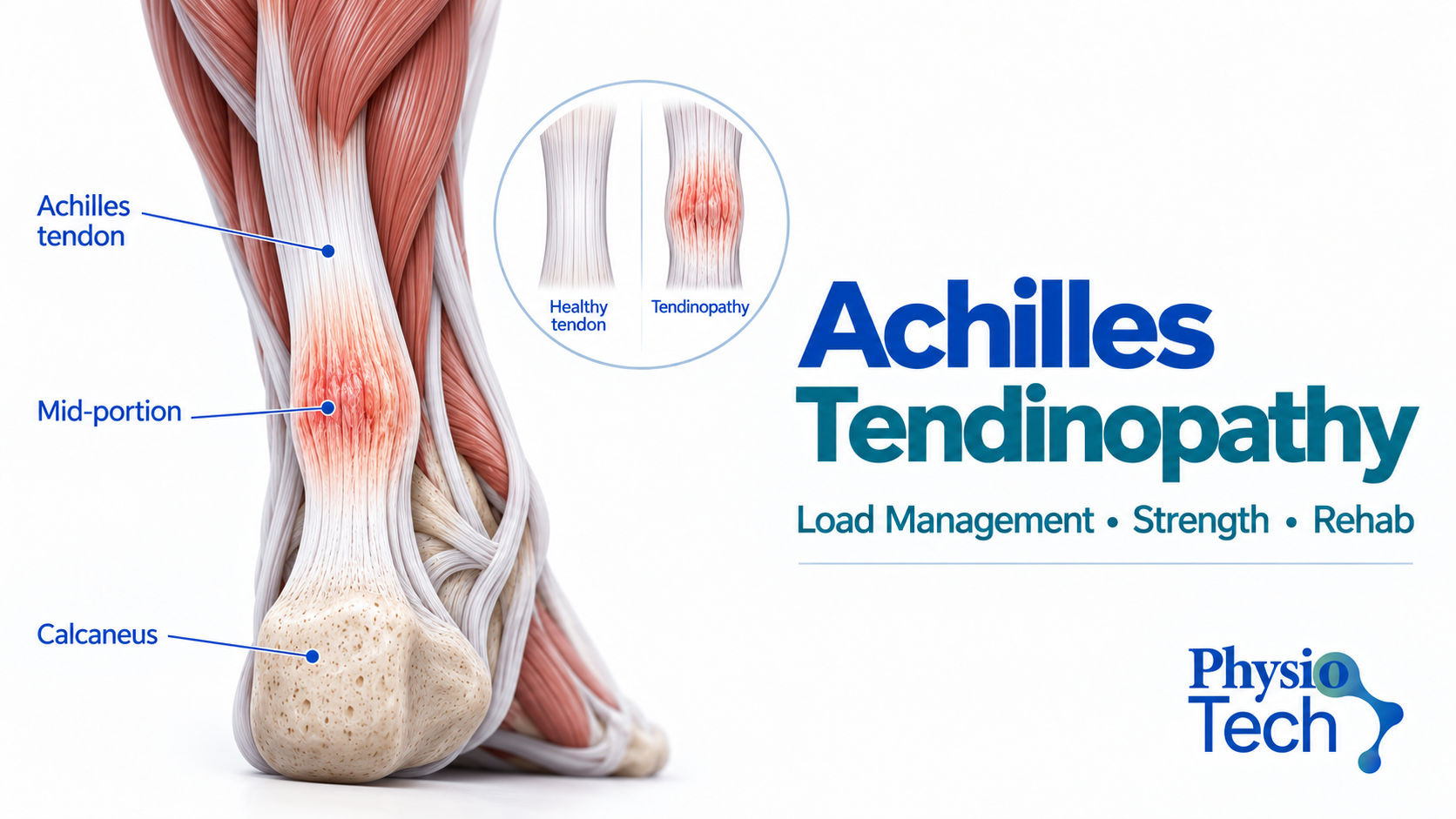
The Achilles is the body’s largest tendon, connecting the calf muscles to the heel bone. It works during walking, stairs, heel raises, running and jumping. Tendinopathy may affect the midportion of the tendon, usually several centimetres above the heel, or the insertion where it joins the heel bone. Distinguishing these presentations matters because exercise range and compression may need to be modified.
Common Achilles tendinopathy symptoms
Typical features include:
• Pain or stiffness behind the ankle or above the heel.
• Morning stiffness that eases partly with movement.
• Pain with running, jumping or climbing stairs.
• Tenderness or local thickening of the tendon.
• Pain or weakness during a heel raise.
• Symptoms that ease during warm-up but increase after activity or the next morning.
Sudden severe pain, a snapping sensation or loss of push-off may indicate an Achilles rupture rather than chronic tendinopathy and needs urgent medical assessment.
Why does Achilles tendon pain develop?
The most common pattern is an increase in load that exceeds the tendon’s current capacity. Examples include rapidly increasing running distance or speed, adding repeated jumps, returning after a break or changing training surface. Reduced calf strength and endurance, limited recovery, some health conditions or medications and previous lower-limb injury may also contribute.
No single factor explains every case. Foot shape or footwear alone should not be treated as a diagnosis; assessment should connect relevant factors to the patient’s actual symptoms and goals.
How is Achilles tendinopathy assessed?
Diagnosis is usually based on history and clinical examination. The physiotherapist identifies the pain location and behaviour under load, then assesses ankle movement, calf strength and endurance, walking, single-leg heel raises and, when appropriate, hopping or running.
Every patient does not need an MRI or ultrasound scan. Imaging may be appropriate when a rupture or another condition is suspected, or when symptoms are unusual and progress differs from expectations. Imaging findings alone do not determine pain severity or readiness to return to sport.
Achilles tendinopathy treatment at PhysioTech
Modern clinical guidance recommends tendon-loading exercise as first-line care, with dosage adapted to symptoms, capacity and goals.
1. Education and load management
Treatment rarely means complete rest. Running, jumping or prolonged walking may be adjusted temporarily and then rebuilt. Monitoring pain during activity and the following day helps the clinician select a tolerable dose.
2. Progressive calf and tendon loading
Rehabilitation may begin with isometric exercise or two-leg heel raises, then progress to single-leg work, additional resistance and different speeds. Eccentric exercise is not the only option; several loading approaches can be effective when they are progressive and appropriate.
3. Power and sports preparation
Returning to running and sport requires more than pain-free walking. The programme develops calf strength, endurance and rate of force, before introducing hopping, jumping, running and change of direction according to sporting demands.
4. Manual therapy
Manual Therapy may assist ankle mobility or surrounding tissue restrictions when examination shows that they affect function. It remains an adjunct to active rehabilitation rather than a replacement for loading exercise.
5. Supportive modalities
Kinesio Taping, Electrotherapy or Therapeutic Ultrasound may be used in selected cases to support symptom management or movement, but passive tools alone cannot rebuild tendon capacity. Dry Needling may be considered for relevant calf muscle trigger points after assessment; it is not presented as a routine procedure inside the tendon.
Can I keep running?
The answer depends on pain, capacity and sporting level. Some patients can continue a modified running dose, while others benefit from temporary alternatives such as cycling. The goal is to find a tolerable workload and progress it—not to test the tendon maximally every day or keep it completely inactive.
How long does recovery take?
Recovery is usually gradual and may take several months, particularly in persistent cases. Progress is influenced by tendon capacity, training demands, programme adherence, sleep and general health. Early pain relief does not automatically mean that strength and readiness for full-speed running have returned.
When is urgent medical review needed?
Seek urgent care after a sudden snap or pop, rapid swelling or bruising, or loss of the ability to push off or rise onto the toes. Marked redness and heat, fever, a wound, worsening night pain or symptoms beginning after a medication associated with tendon problems also require medical review.
Returning to running and sport
Return-to-sport assessment may include single-leg heel-raise capacity, calf strength, hopping performance, running tolerance and the next-day symptom response. Training progresses from controlled and straight-line tasks to speed and change of direction according to the athlete’s sport.
Why choose PhysioTech for Achilles rehabilitation?
At PhysioTech Clinic in Zahraa El Maadi, Cairo, physiotherapists assess pain location, ankle movement, calf capacity and sporting load. The individual plan centres on Exercise Therapy and load management, with Manual Therapy, Kinesio Taping, Dry Needling and appropriate supportive modalities when clinically relevant.
If Achilles pain limits walking, running or sport, book an assessment at PhysioTech for a progressive plan matched to your condition and goals.
Scientific reference
Chimenti RL, et al. Achilles Pain, Stiffness, and Muscle Power Deficits: Midportion Achilles Tendinopathy Revision 2024. Journal of Orthopaedic & Sports Physical Therapy.
This article is educational and does not replace an individual medical assessment.


