Share:
76 views
#مرفق لاعب الجولف #ألم داخل الكوع #التهاب أوتار الكوع #تمارين الأوتار #PhysioTech
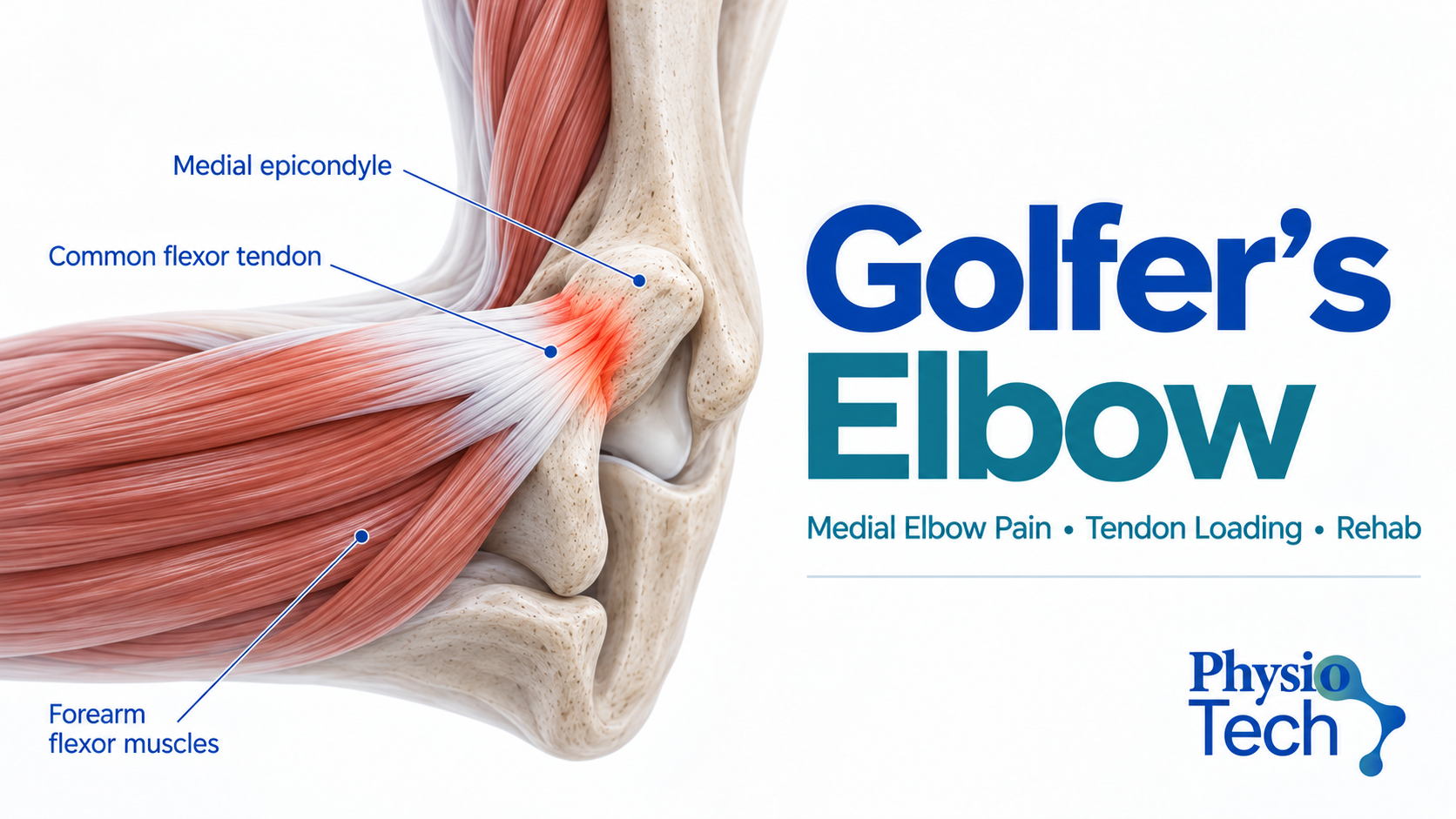
Golfer’s elbow, or medial epicondylalgia, is pain related to the common flexor tendon origin on the inner side of the elbow. It is not limited to golfers. Resistance training, manual work, carrying, tool use and a sudden increase in gripping volume can all contribute.
اقرأ المقال بالعربيةTypical symptoms
- Local pain at the inner bony prominence of the elbow.
- Pain with gripping, lifting or resisted wrist flexion.
- Reduced grip confidence or difficulty opening a jar.
- Morning stiffness or pain after activity.
Numbness in the ring and little fingers may indicate ulnar nerve irritation or cubital tunnel syndrome rather than an isolated tendon problem.
Clinical assessment
Assessment examines pain location, grip strength, resisted forearm tests, elbow and wrist movement, and recent work or sport load. The ulnar nerve and neck are screened when symptoms include tingling or radiating pain. Imaging is not always required, but may be appropriate after acute trauma, joint locking, marked weakness or an unusual clinical course.
Rehabilitation
Manage provocative load
Modify the most painful tasks without completely avoiding arm use. Grip choice, training volume, tool setup and work-rest distribution can be adjusted.
Progressive tendon exercise
Exercise may begin with tolerable isometric or light resistance work and progress toward forearm, grip and task-specific loading. The aim is to build the tendon’s capacity.
Address contributing factors
Wrist and shoulder mobility, upper-limb strength and lifting technique may be relevant. Manual therapy or dry needling can be used selectively for symptom or muscle components, but they are adjuncts and do not replace graded loading.
When to seek medical review
Severe pain after trauma, substantial swelling, deformity, progressive loss of strength, persistent numbness or symptoms that fail to improve with sensible load modification require medical assessment.
FAQ
Does an elbow strap help?
It may help selected patients during a specific task, but it is not a stand-alone treatment and does not build tendon capacity.
Are stretches enough?
Usually not. Stretching may change comfort, but rehabilitation generally needs progressive resistance and functional exercise.
Does dry needling repair the tendon?
It may be an adjunct for selected pain or muscular components. Assessment, load management and exercise remain the foundation.
Local CTA
If inner elbow pain limits work or training, book an assessment at PhysioTech Clinic in Zahraa El Maadi to distinguish tendon pain from nerve symptoms and build a suitable plan.
Suggested internal links: Cubital Tunnel Syndrome; Tennis Elbow; Dry Needling; Manual Therapy; Therapeutic Exercise.