Share:
98 views
#Hamstring Strain #Hamstring Tear #Hamstring Rehab #Football Injury #Running Injury #Sports Injury #Return to Sport #Physiotherapy Cairo
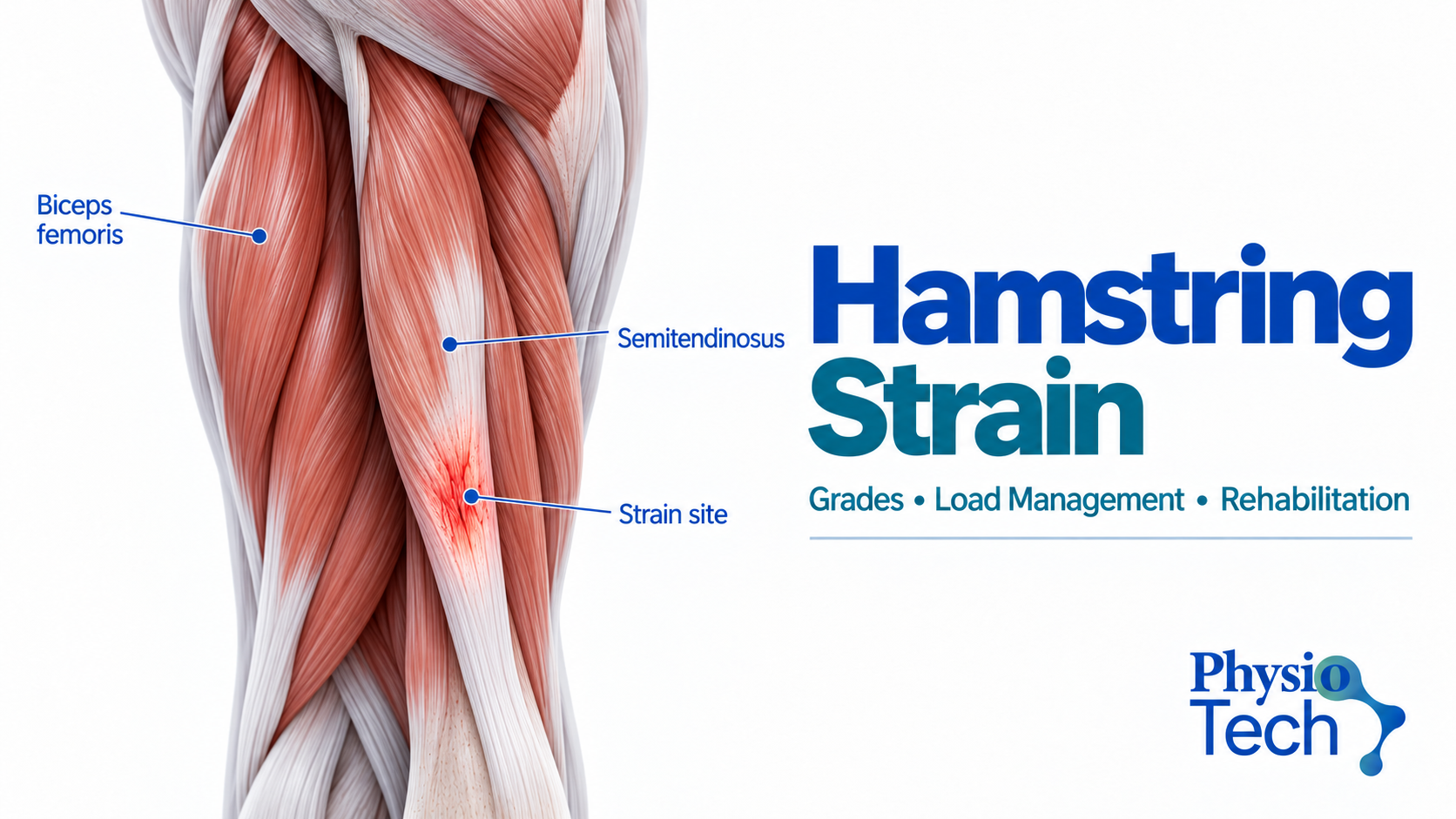
A hamstring strain is one of the most common injuries in football, sprinting and high-speed sport. It may occur during maximal running or when the leg is forcefully lengthened, ranging from a mild strain to a major tear. Early structured rehabilitation followed by progressive strength and speed exposure supports return to sport and helps reduce reinjury risk.
What are the hamstring muscles?
The hamstrings are located at the back of the thigh and cross the hip and knee. They help bend the knee, extend the hip and control the leg during running, jumping and change of direction. They experience very high forces during sprinting, particularly while lengthening and producing force at the same time.
Common hamstring strain symptoms
Symptoms may include:
• Sudden pain at the back of the thigh during running or acceleration.
• A strong pulling or popping sensation.
• Pain with fast walking or knee extension.
• Weakness when bending the knee or driving the body forward.
• Swelling or bruising in larger injuries.
• Local tenderness in the muscle or near its attachment at the pelvis or knee.
A mild injury may still allow walking, but this does not rule out a tear that needs rehabilitation.
Hamstring injury grades
Clinicians may describe injuries in three grades:
• Grade 1: a mild injury with limited pain and small strength loss.
• Grade 2: a partial tear with greater pain, weakness, bruising or running difficulty.
• Grade 3: a severe or complete tear with marked loss of function.
Grade alone does not determine return time. Injury location, tendon involvement, previous injury and sporting demands also matter.
How is a hamstring injury assessed?
Assessment begins with the injury mechanism, pain location and ability to walk or run. The physiotherapist examines movement range, knee-flexion and hip-extension strength, pain under resistance, trunk and pelvic function and the response to progressively demanding tasks.
MRI or ultrasound imaging may be appropriate when a major tear or tendon avulsion is suspected, when bruising is extensive or when diagnosis is unclear. Rehabilitation and return-to-sport decisions should not depend on imaging alone.
Early management after injury
During the first few days, care aims to protect the tissue, manage pain and swelling and preserve safe movement. Appropriate compression, elevation, pain-limited movement and simple exercises may be used after assessment. Prolonged complete rest can delay strength recovery, while an immediate return to sprinting may overload the injury; appropriate progression is essential.
Hamstring rehabilitation at PhysioTech
Current consensus recommends individual rehabilitation based on the athlete, involved tissue and sporting demands.
1. Restore movement and control
Early exercises maintain tolerable movement and begin activating the hamstrings, hips and trunk. Forceful stretching and maximal loading are avoided in the irritable stage.
2. Progressive hamstring strengthening
Training develops from isometric exercise to dynamic resistance and loading at different muscle lengths. Later stages include eccentric training to prepare the hamstrings for high-force running demands.
3. Hip and trunk training
Hamstring function is part of a kinetic chain involving the pelvis, trunk and lower limb. Gluteal, trunk and movement-control exercises may be included when relevant.
4. A graded return to running
Running starts at low speed before distance and intensity increase. High-speed exposure is important because many injuries occur during sprinting; pain-free jogging alone does not prove readiness for sport.
5. Agility and change of direction
Acceleration, deceleration, change-of-direction, jumping and football- or sport-specific skills are added after an adequate strength and running base has been developed.
6. Manual therapy and supportive modalities
Manual Therapy may be used for relevant movement restrictions. Kinesio Taping, Electrotherapy or Therapeutic Ultrasound may assist symptom management in selected cases. Dry Needling can be considered for suitable trigger points or muscle tightness at an appropriate stage. These tools do not replace progressive strength and running.
How long does recovery take?
A mild strain may recover within weeks, while larger tears or injuries involving the tendon may take longer. Setting an exact date before assessment is unreliable. Readiness depends on strength, running speed and sports skills, together with a stable response later that day and the next morning.
Why do hamstring strains recur?
Previous injury, returning before strength and sprint capacity are restored, missing high-speed running in rehabilitation and increasing training load too rapidly can contribute. Prevention includes ongoing strength work, load management and planned exposure to speed.
When is urgent medical assessment needed?
Seek prompt assessment with severe pain, extensive swelling or bruising, inability to walk, a palpable gap in the muscle or sharp pain near the sitting bone after a forceful movement. These features may indicate a major tear or proximal tendon avulsion.
Return-to-sport criteria
Criteria may include suitable movement range, strength approaching the other limb, tolerance of resistance exercise at different muscle lengths, high-speed running, acceleration, deceleration and change of direction without a lasting flare-up. Testing should match the athlete’s sport and position.
Why choose PhysioTech for hamstring rehabilitation?
At PhysioTech Clinic in Zahraa El Maadi, Cairo, rehabilitation begins with assessment of injury location, hamstring and hip strength, running function and sporting demands. Physiotherapists build a progressive Exercise Therapy plan, with Manual Therapy, Kinesio Taping, Dry Needling and supportive modalities added when clinically relevant.
If pain behind the thigh is limiting running or repeatedly returns during training, book an assessment at PhysioTech for a structured return-to-sport plan.
Scientific reference
Paton BM, et al. London International Consensus on Hamstring Injuries: Rehabilitation, Running and Return to Sport. British Journal of Sports Medicine. 2023.
This article is educational and does not replace an individual medical assessment.


