Share:
111 views
#Patellofemoral Pain #Runner's Knee #Anterior Knee Pain #Knee Pain #Sports Injury #Physiotherapy Cairo #Zahraa El Maadi #Exercise Therapy
Pain at the front of the knee is common in runners, athletes and active adults, but it can also develop with prolonged sitting, stairs or a sudden increase in everyday activity. The clinical term is patellofemoral pain, describing pain around or behind the kneecap when no single traumatic injury explains the symptoms. Effective rehabilitation requires understanding the loads that trigger pain, assessing knee and hip capacity and building a progressive programme around the patient’s goals.
What is patellofemoral pain?
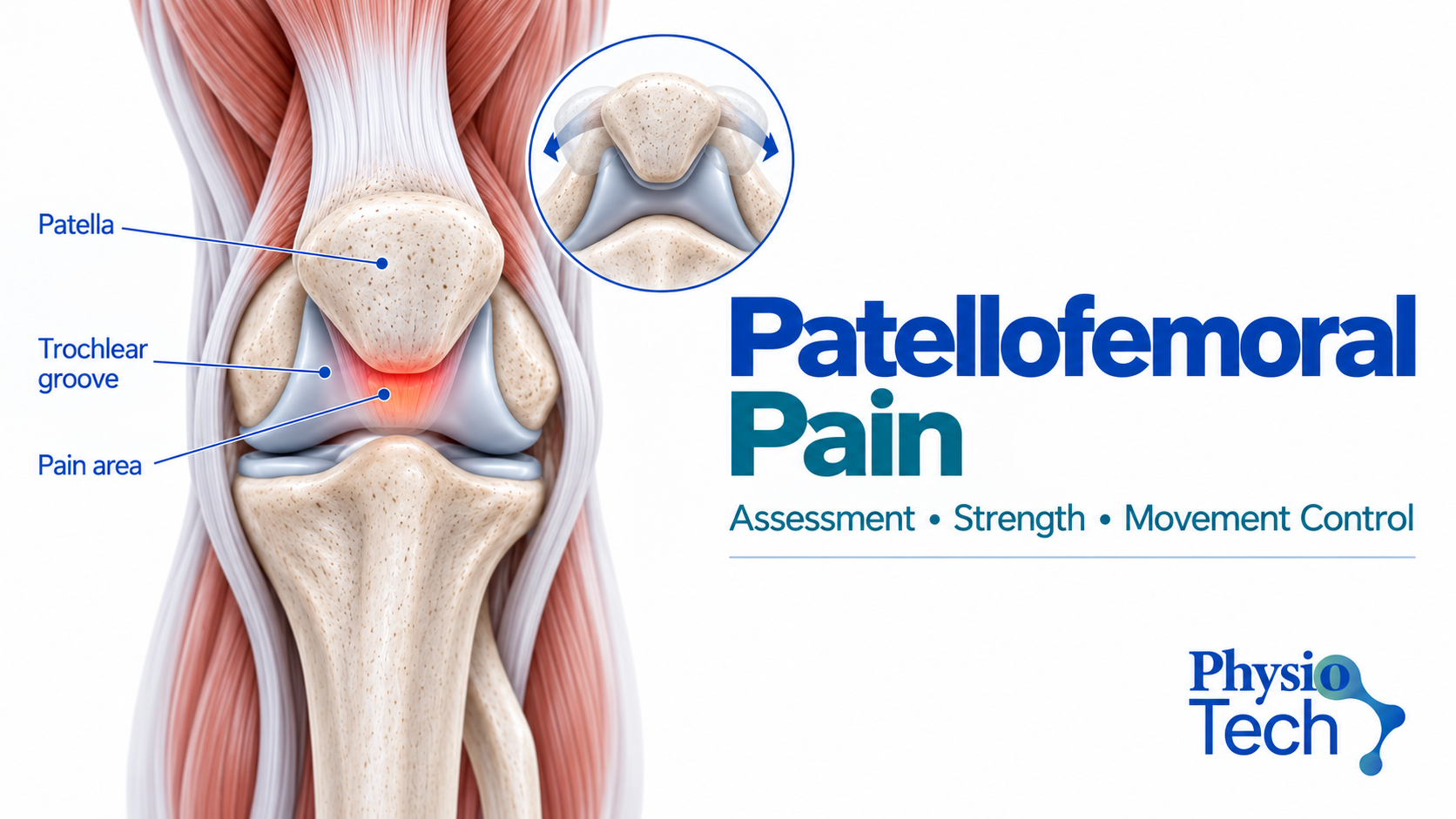
Patellofemoral pain is felt around the joint between the kneecap and the thigh bone. It is sometimes called runner’s knee, anterior knee pain or chondromalacia, although these terms are not always interchangeable. Clicking or grinding does not automatically mean cartilage damage, and pain severity cannot be judged from an imaging result alone.
Common symptoms of kneecap pain
Symptoms may include:
• Pain around or behind the kneecap.
• Increased pain when climbing or descending stairs.
• Pain during squatting, running or jumping.
• Discomfort after sitting with the knee bent for a long time.
• Difficulty increasing walking distance or training volume.
• Clicking or grinding without major swelling in some cases.
Pain may affect one or both knees and often changes according to training volume, daily loading and recovery.
Why does patellofemoral pain develop?
There is rarely one single cause. Symptoms can emerge when running, jumping or leg-training loads increase faster than the knee’s current capacity. Reduced strength or endurance in the quadriceps and hip muscles, altered movement strategies, limited recovery or returning to sport before capacity is restored may contribute. Ankle mobility and running or landing mechanics can also matter for selected patients.
This does not mean that every foot position or knee angle is a permanent fault. Assessment should identify modifiable factors that are relevant to the individual rather than trying to make everyone move in one identical way.
How is patellofemoral pain assessed?
Diagnosis is usually clinical. The physiotherapist asks about the exact pain location, aggravating tasks and recent changes in activity, then examines knee, ankle and hip movement, quadriceps and hip strength, balance and performance during a squat, step or running task when appropriate.
Every patient does not need an MRI. Imaging or medical referral may be appropriate after major trauma or when there is substantial swelling, true joint locking, inability to bear weight or concern about another condition such as a meniscus, ligament or advanced joint problem.
Patellofemoral pain treatment at PhysioTech
Current best-practice guidance places education and knee-targeted exercise at the centre of treatment, with supporting interventions selected according to the patient’s presentation.
1. Education and load management
Activities that clearly aggravate pain—such as running, jumping or deep squatting—may be adjusted temporarily rather than stopped completely. Volume, intensity, range or frequency can then be rebuilt gradually using symptoms, strength and function as guides.
2. Knee strengthening exercises
Quadriceps training improves the knee’s capacity for stairs, running and sitting-to-standing tasks. Exercises may begin in comfortable positions and progress toward squats, step-ups, step-downs and single-leg tasks according to tolerance and goals.
3. Hip and gluteal strengthening
Hip and gluteal training may be added when weakness or reduced lower-limb control is relevant. Combining knee and hip exercises is useful for many patients, but exercise selection and dosage should remain individual.
4. Movement and running retraining
For active patients, the physiotherapist may assess squatting, landing or running. Selected technique changes or an adjustment in step rate can be introduced when testing shows that they reduce symptoms or improve load management. No single running style is required for everyone.
5. Patellar or kinesio taping
Taping may provide short-term pain relief and make exercise easier for some patients. Its effect is usually supportive, so it is combined with progressive rehabilitation rather than used alone.
6. Manual therapy and other adjuncts
Manual Therapy may be used when a relevant restriction in knee or ankle movement is present. Electrotherapy or Therapeutic Ultrasound can be considered as supportive tools in selected cases but do not replace education and progressive exercise. Dry Needling may be used for specific muscle trigger points or tightness after assessment; it is not presented as a universal treatment for kneecap pain.
Should I avoid squats and stairs?
Not necessarily. Squatting and stair use are normal and important movements. Depth, repetitions, speed or external weight may be reduced temporarily, then progressed as capacity improves. Avoiding the movement for too long can reduce strength and confidence and make return to activity harder.
How long does recovery take?
Recovery varies with symptom duration, training and daily load, strength, sleep, programme adherence and associated conditions. Some patients notice progress within weeks, but restoring full capacity and returning to sport may take several months. There is no fixed session count or single exercise that suits every presentation.
When does knee pain need urgent medical assessment?
Seek prompt assessment after an injury with major swelling, inability to bear weight, visible deformity or true locking that blocks knee movement. Redness and heat with fever, worsening night pain, unexplained weakness or numbness also require medical attention.
Returning to running and sport
Return should not depend only on whether pain has disappeared. Rehabilitation may assess side-to-side strength, control during squatting and hopping, running tolerance, change-of-direction tasks and the knee’s response in the hours after training. A graded return helps restore confidence while reducing repeated flare-ups.
Why choose PhysioTech for anterior knee pain?
At PhysioTech Clinic in Zahraa El Maadi, Cairo, care begins with a detailed assessment of knee and ankle movement, quadriceps and hip strength and the patient’s work or sporting demands. Our physiotherapists develop an Exercise Therapy and load-management plan and may add Manual Therapy, Kinesio Taping, Dry Needling or appropriate supportive modalities when clinically relevant.
If pain around the kneecap is limiting stairs, running or training, book an assessment at PhysioTech for a safe, goal-based physiotherapy plan.
Scientific references
Neal BS, et al. Best Practice Guide for Patellofemoral Pain. British Journal of Sports Medicine. 2024.
Willy RW, et al. Patellofemoral Pain: Clinical Practice Guideline. Journal of Orthopaedic & Sports Physical Therapy. 2019.
This article is educational and does not replace an individual medical assessment.


