Share:
153 views
#تثبيت الكسور #intramedullary nail #ORIF #تأهيل بعد العمليات
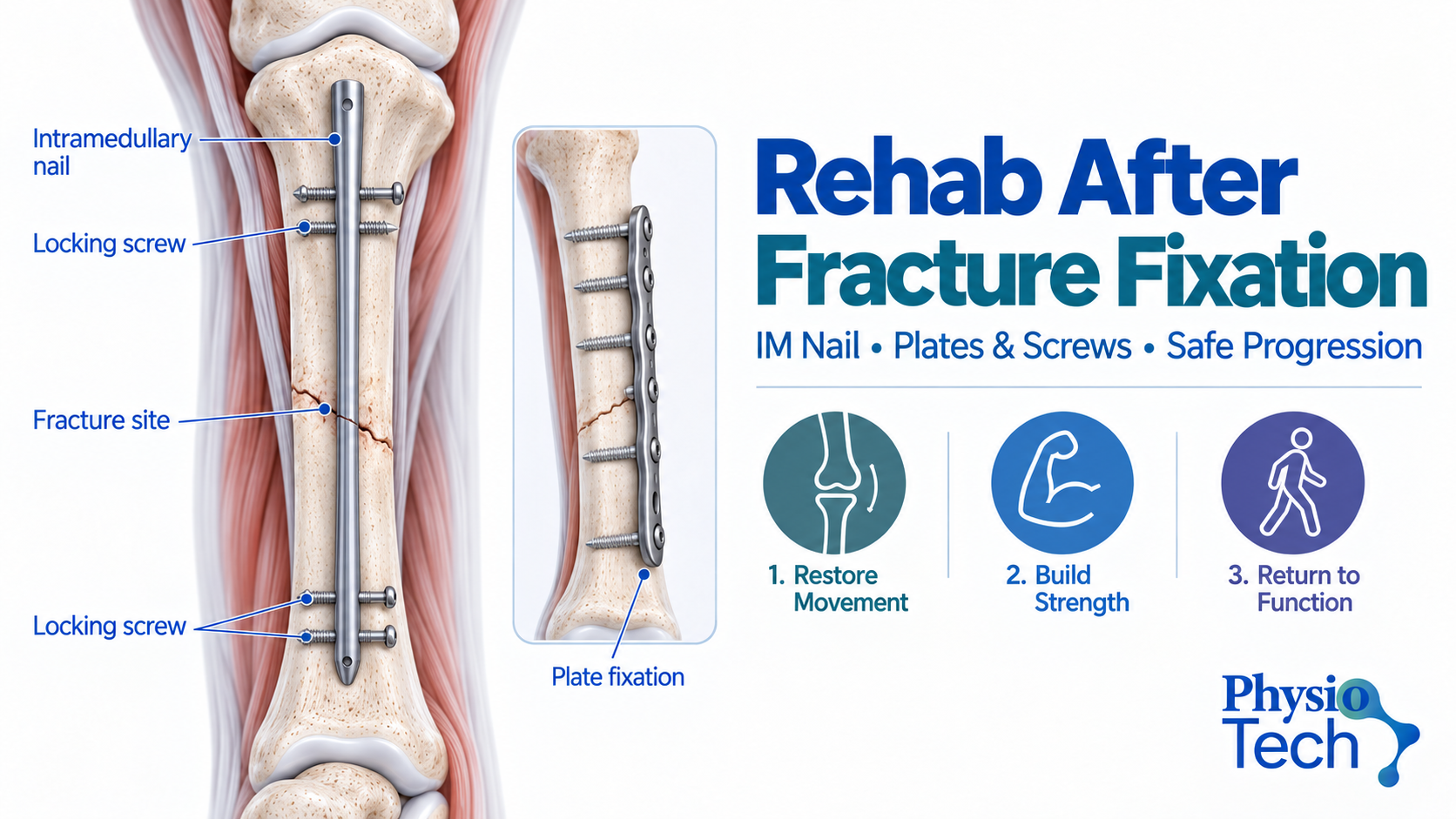
Fracture fixation maintains alignment and stability while bone healing occurs. Common constructs include an intramedullary nail (IM nail) inside the bone canal with locking screws, or plates and screws on the bone surface. “Intramedullary screw” is not the usual general name for most of these constructs; IM nail or rod with locking screws is more accurate.
اقرأ المقال بالعربيةFixation does not mean the bone is instantly healed, and no single weight-bearing rule fits every patient. Rehabilitation depends on the bone, fracture location and pattern, bone quality, soft-tissue injury, construct stability, imaging and the surgeon’s instructions.
Physiotherapy goals
• Protect the fracture and wound while reducing immobility complications.
• Restore permitted movement in nearby joints.
• Activate muscles and limit strength loss.
• Train transfers and gait with the correct aid.
• Progress loading, strength and balance after clearance.
• Return to home, work and sport using functional criteria.
General rehabilitation phases
Early protection and safe mobility
The surgeon’s order is checked carefully: non-weight bearing, touch-down, partial or weight bearing as tolerated. Training covers crutches or a walker, permitted joint movement, circulation and breathing exercises, and early muscle activation. Wound, swelling and pain are monitored.
Restore range and control
As allowed, hip, knee or ankle movement and surrounding muscle activation progress. The goal is to reduce stiffness without exceeding fixation or soft-tissue restrictions.
Progressive weight bearing and strength
The therapist does not independently change weight-bearing status. Progression follows the surgeon’s prescription, radiographic review and patient response. Exercise advances from control and balance to resistance, stairs and longer walking.
Return to function
Gait quality, strength, range, balance and work tasks are measured. Running or sport requires adequate healing, medical clearance and functional testing rather than a fixed number of weeks.
Does IM-nail rehab differ from plate fixation?
Some IM-nail constructs permit earlier loading in selected fractures, while certain plated or complex fractures need longer protection. There are many exceptions; hardware name alone cannot determine the plan. Fracture-specific surgical instructions and follow-up imaging are the reference.
Post-operative red flags
Contact the medical team urgently for chest pain or breathlessness, unusual calf swelling and pain, fever or wound discharge, rapidly increasing pain, new sensory or motor loss, a cold or discolored limb, or a new fall.
Electrotherapy may support activation of a markedly inhibited muscle in selected cases, and manual therapy may later address permitted joint or soft-tissue restrictions. Therapeutic ultrasound and kinesio taping do not replace fracture protection, exercise or prescribed loading. Dry needling is not used near an early surgical wound without appropriate assessment and precautions.
FAQ
When can I walk after an IM nail?
Some patients mobilize early with an aid and prescribed loading; others require protection. Follow the written surgeon order rather than another patient’s timeline.
Does a plate prevent joint movement?
Not necessarily. Nearby joints often move early within restrictions, but the permitted range depends on the fracture, soft tissues and fixation.
When can I stop using crutches?
After appropriate loading is permitted and control, strength and gait quality are adequate—not simply because pain is lower.
Local CTA
After reviewing the operation report and surgeon’s instructions, PhysioTech Clinic in Zahraa El Maadi, Cairo can build a safe plan for mobility, strength, gait and functional follow-up.


