Share:
194 views
#إصابات الأوتار #tendinopathy #partial tear #tendon rupture
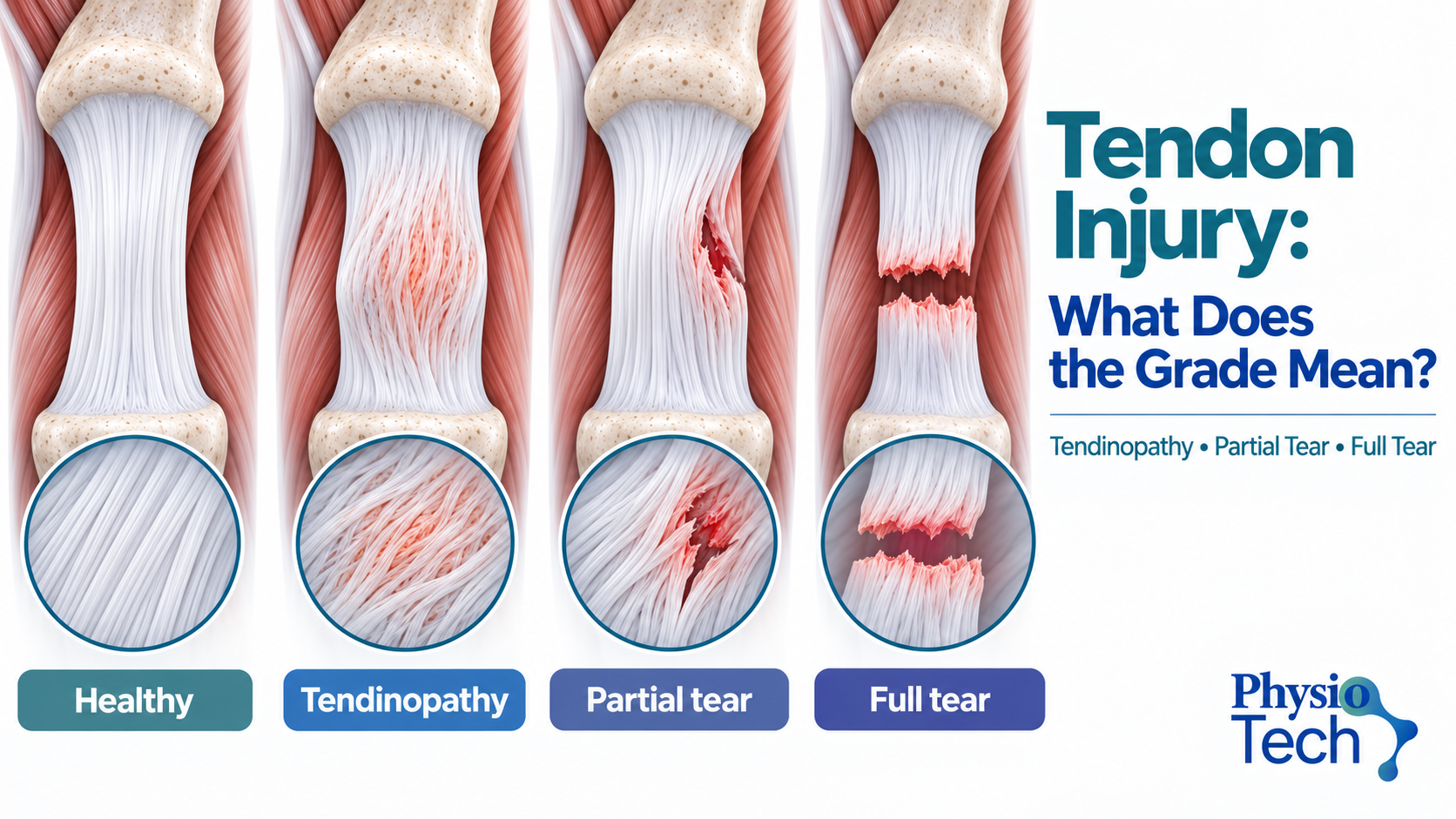
Patients often ask, “What grade is my tendon inflammation?” The accurate answer is that tendinopathy does not have one universal grade 1–3 system that applies to every tendon. Some reports grade tears or the percentage of tendon thickness involved; other models describe a tissue continuum. The label must therefore be interpreted for the specific tendon, examination and imaging method.
اقرأ المقال بالعربيةKey terms
Tendinitis
This implies acute inflammation and may fit some short-duration presentations, but it does not describe every persistent tendon pain condition.
Tendinopathy
This broader clinical term describes tendon-related pain and reduced load capacity. Thickening or altered fiber organization may appear on imaging, but scan severity does not always match pain.
Partial tear
Some fibers are disrupted while part of the tendon remains continuous. Clinical importance depends on depth, location, function and symptoms—not the number alone.
Full-thickness tear or rupture
Tendon continuity is completely lost. Some tendons and acute patterns require timely surgical opinion, especially with sudden functional loss.
What do grades 1, 2 and 3 mean?
For some musculotendinous injuries, clinicians use a broad scheme: grade 1 for minor injury, grade 2 for partial tear and grade 3 for complete rupture. This should not be copied automatically to every chronic tendinopathy. Ask what tissue is involved, the tear proportion, whether function is preserved and how the finding changes management.
Does MRI decide treatment?
No. Management integrates injury mechanism, pain, strength, function, age and goals, with imaging when appropriate. Structural changes can exist without symptoms, and substantial pain can occur with limited scan change.
Physiotherapy role
For tendinopathy and selected partial tears, rehabilitation manages load and progressively restores range, strength and function. Complete rupture or sudden power loss requires medical referral; physiotherapy may continue before or after surgery according to the medical plan.
Manual therapy, dry needling, kinesio taping, electrotherapy or therapeutic ultrasound may be adjuncts when clinically justified. They do not reconnect a ruptured tendon and do not replace assessment or progressive loading.
FAQ
Does a higher grade always mean more pain?
No. Tissue appearance, pain and function do not have a simple linear relationship.
Does every partial tear need surgery?
No. The tendon, tear size and location, weakness, patient demands and response to conservative care all matter.
Is exercise safe with tendinopathy?
Progressive exercise is usually central to care, but its type and dose should follow assessment.
Local CTA
If your scan report contains confusing tendon terminology, book an assessment at PhysioTech Clinic in Zahraa El Maadi, Cairo to connect the report with movement, strength and function.