Share:
125 views
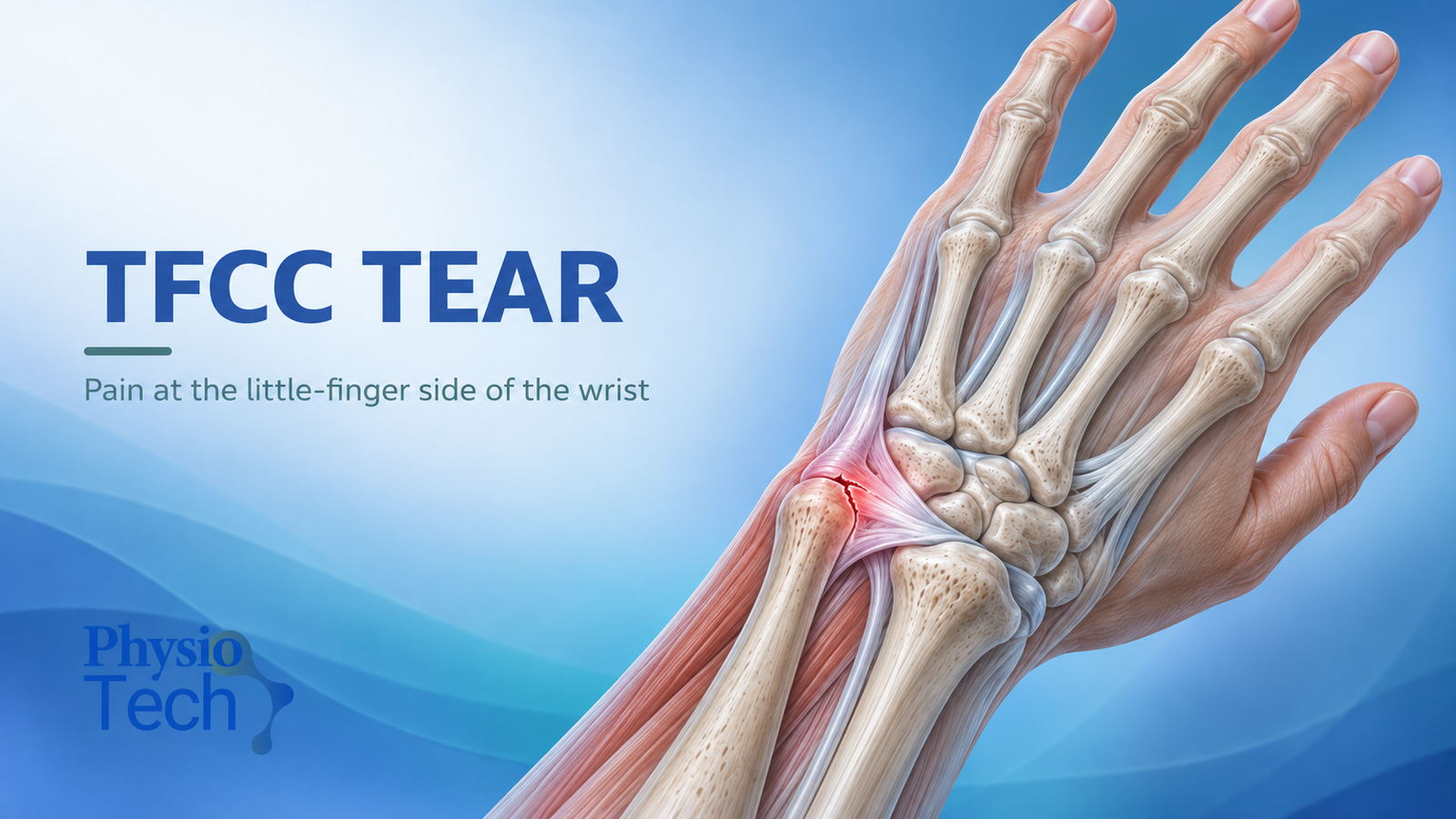
Pain on the little-finger side of the wrist does not automatically mean that the triangular fibrocartilage complex is torn, but a TFCC injury is an important possibility after a fall, forceful rotation or repeated loading at work, in the gym or during sport. The triangular fibrocartilage complex is a group of cartilage and ligament structures that supports the ulnar side of the wrist, helps stabilise the distal radioulnar joint and distributes load during gripping, rotation and weight-bearing.
اقرأ المقال بالعربيةThis guide explains TFCC tear symptoms, how ulnar-sided wrist pain is assessed, the role of physiotherapy and graded rehabilitation, and when specialist medical review may be needed.
What Is the Triangular Fibrocartilage Complex?
The TFCC lies between the distal ulna and the small carpal bones on the little-finger side of the wrist. It contributes to shock absorption and stability, particularly during forearm rotation and tasks that combine gripping with axial load.
Because the TFCC is a complex of several tissues rather than one isolated piece of cartilage, injury patterns differ. A patient may have irritation or degenerative change, a stable tear, or a tear associated with distal radioulnar joint instability. Treatment must therefore be based on the individual presentation rather than the label alone.
What Causes a TFCC Tear?
Traumatic TFCC Injury
A traumatic tear may follow a fall onto an outstretched hand, a forceful twisting movement, or lifting while the wrist is deviated. TFCC injury may also occur alongside a distal radius fracture or in sports that repeatedly combine grip, rotation and impact.
Repetitive Load and Degenerative Change
Symptoms can develop gradually in racket-sport athletes, weightlifters and people who use rotational tools or strong grip repeatedly. Degenerative TFCC changes are also common and may appear on imaging without causing symptoms. An MRI finding should therefore be interpreted with the clinical assessment.
Common TFCC Tear Symptoms
The typical complaint is ulnar-sided wrist pain. Symptoms may increase when opening a jar, turning a key or door handle, carrying a bag, using tools, pushing up from a chair, or performing push-ups and planks. Some patients notice clicking, swelling, weaker grip, reduced forearm rotation or a feeling that the wrist is unstable.
Other conditions can produce similar pain, including ECU tendon irritation or instability, other ligament injuries, joint degeneration, occult fracture and neural sensitivity. Location alone and a single test cannot confirm the diagnosis.
How Is a TFCC Injury Diagnosed?
History and Clinical Examination
Assessment begins with the mechanism of injury, aggravating tasks, symptom behaviour and the demands of work or sport. Examination may include wrist and forearm movement, grip strength, response to palpation, joint stability and graded weight-bearing tolerance.
Imaging and Specialist Review
X-rays may help exclude fracture and assess bony factors. A hand specialist may request MRI or further investigation when the result is likely to change management. Imaging does not replace clinical reasoning because structural TFCC changes may be present without pain.
Non-Surgical Treatment for a TFCC Tear
Many stable presentations begin with conservative management. Depending on irritability and stability, this may include temporary modification of painful tasks, avoiding repeated heavy rotation or weight-bearing, and using a wrist support for a defined period when appropriate.
The aim is not indefinite rest. Rehabilitation protects the wrist when necessary, then restores movement, strength and load tolerance progressively. Prolonged avoidance can leave weakness and fear of movement, while returning to heavy load too quickly may aggravate symptoms.
Physiotherapy and TFCC Rehabilitation Stages
Stage One: Settle Symptoms and Protect the Wrist
Provocative tasks are identified and modified while finger, elbow and shoulder movement is maintained. A brace or kinesio taping may support selected patients, but these are temporary aids and do not replace assessment, exercise and reassessment.
Stage Two: Restore Motion and Control
Appropriate wrist movement and forearm rotation are reintroduced without excessive symptom aggravation. Isometric exercise and controlled activation may help rebuild support around the wrist and distal radioulnar joint. Manual therapy can be used when the assessment identifies a relevant movement restriction, as part of an active programme rather than a stand-alone treatment.
Stage Three: Build Grip and Wrist Strength
Exercise progresses from light resistance toward wrist, forearm and grip strength, endurance and rotation control. Dosage is adjusted according to symptoms during training and the response over the following day, not a rigid protocol.
Stage Four: Return to Work, Gym and Sport
Gripping, rotation and weight-bearing are rebuilt in steps. A gym patient may move from neutral-grip and reduced-load options toward more demanding pressing, while an athlete or manual worker needs task-specific preparation. Return is based on movement, strength, stability and confidence as well as pain.
Our Clinic Follows an Assessment-Led Approach
Our clinic follows an individual assessment-led approach at PhysioTech Clinic in Cairo. We do not treat the MRI report alone and we do not give every patient the same exercise sheet. Symptoms are connected to movement, load tolerance, work, sport and daily hand use before the rehabilitation plan is selected.
Our approach uses clinical reasoning, exercise therapy and measurable graded loading, with manual therapy, taping or available physical modalities used only when they have a clear supportive role. Progress is reassessed against the patient’s functional goal rather than the number of sessions alone.
Does Every TFCC Tear Need Surgery?
No. Many stable injuries can improve with activity modification, temporary support and structured rehabilitation. Clear instability, major trauma, persistent mechanical symptoms or limited progress after appropriate conservative treatment may require review by a hand surgeon. Injection, arthroscopy or repair decisions are medical decisions based on tear pattern, joint stability, tissue condition and patient goals.
When Should You Seek Urgent Medical Review?
Prompt assessment is important after significant trauma when there is deformity, marked swelling, loss of sensation, cold or discoloured fingers, increasing weakness, inability to move the wrist, or inability to use the hand. Persistent or worsening pain after a fall should be assessed to exclude fracture or an unstable injury.
Frequently Asked Questions About TFCC Treatment
Does Clicking Mean the TFCC Is Torn?
No. Clicking alone does not confirm a tear. It becomes more relevant when combined with pain, swelling, weakness, instability and consistent examination findings.
Can I Continue Training at the Gym?
You may need temporary changes to grip, load and weight-bearing exercises rather than complete cessation. The correct modification depends on irritability and current wrist capacity.
How Long Does TFCC Rehabilitation Take?
There is no single recovery timeline. Tear location, stability, symptom duration and functional demands differ. Movement, strength and task tolerance provide better progression markers than a fixed number of weeks.
Does Every Patient Need an MRI?
Not always. The decision begins with history and examination. Imaging is most useful when it helps confirm a differential diagnosis or changes the treatment decision.
TFCC and Wrist Pain Physiotherapy in Cairo
If pain on the little-finger side of the wrist limits work, gym training or daily hand use, you can book an assessment at PhysioTech Clinic in Zahraa El Maadi, Cairo, Egypt. We identify the likely pain source and current load tolerance, then build an individual, measurable rehabilitation plan rather than relying on generic wrist exercises.
Medical Sources
This article was reviewed using patient information from The Hand Society and NHS wrist and TFCC resources. It is educational and does not replace individual medical assessment.