Share:
97 views
#الإصبع الزنادي #تعليق الإصبع #Trigger Finger #أوتار اليد #علاج طبيعي لليد
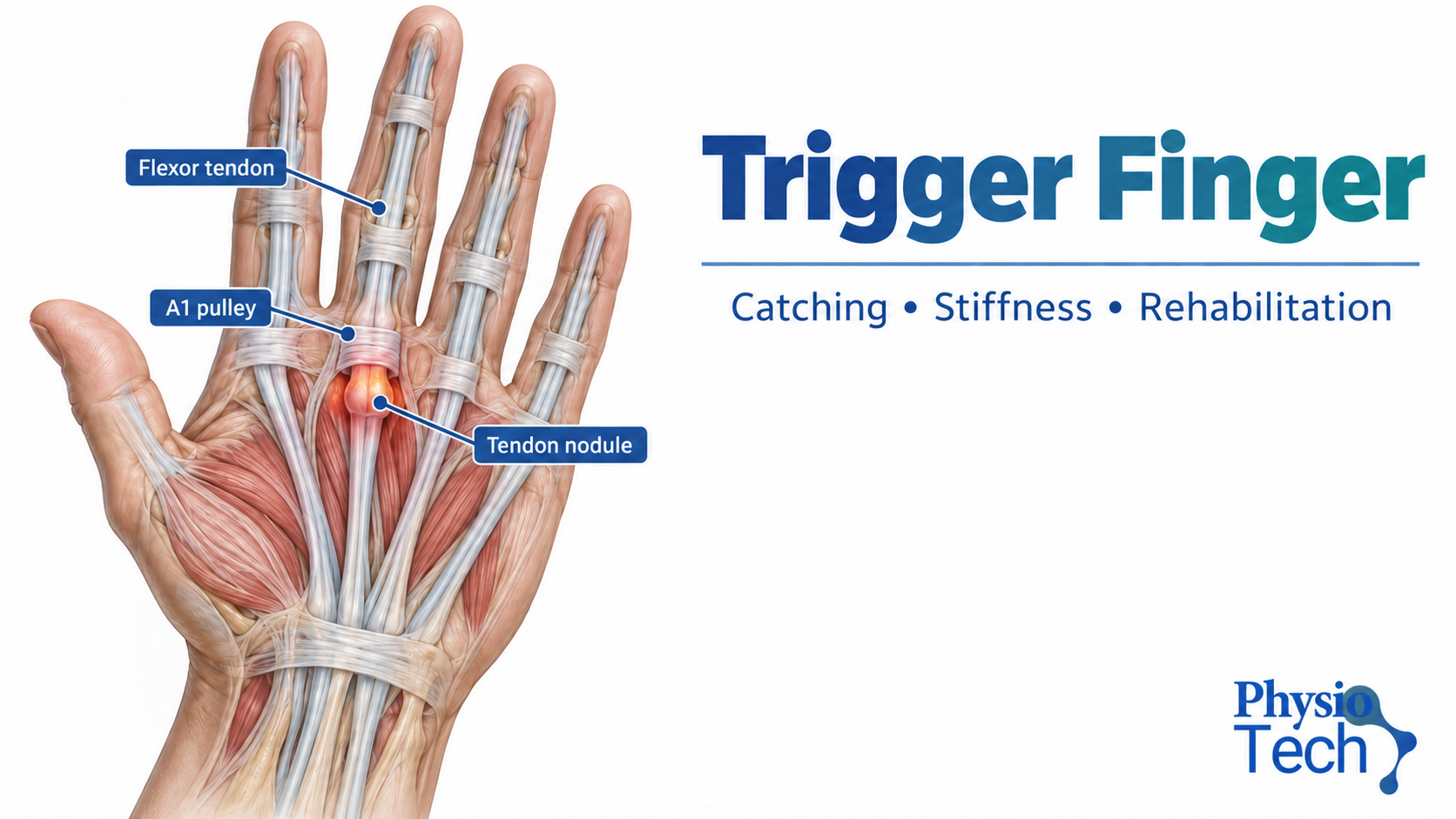
Trigger finger develops when the flexor tendon no longer glides smoothly through the A1 pulley, causing pain, catching or locking. Diabetes and repetitive gripping may increase risk.
Common symptoms
1. Clicking or catching during motion
2. Pain or a tender nodule at the finger base
3. Morning stiffness
4. Needing the other hand to straighten the finger
Why accurate diagnosis matters
Tendon injury, joint arthritis and hand contracture can overlap, so the site and severity of catching must be assessed.
PhysioTech assessment
We assess symptom behaviour, movement, strength, sensation and aggravating factors, while screening the spine, nearby joints and peripheral nerves. No single test or scan determines the plan.
Physiotherapy management
1. Modify repetitive or forceful gripping
2. Use a suitable splint in selected cases
3. Restore tendon glide and motion without forcing a locked finger
4. Progress hand strength after irritability settles
Adjuncts such as manual therapy, dry needling, kinesio taping, electrotherapy or therapeutic ultrasound are used only for a defined supporting goal. They do not replace assessment, exercise, graded loading or outcome review.
When medical review is needed
A fixed locked finger, infection or marked swelling, or persistent functional catching requires hand-specialist assessment.
Book an assessment at PhysioTech
If symptoms affect sleep, work, walking or sport, book an individual assessment at PhysioTech in Zahraa El Maadi to identify the likely driver and build a measured plan.
FAQ
Is clicking alone dangerous?
Not always; pain, locking and functional loss guide assessment.
Does physiotherapy always avoid injection or surgery?
No. Severity and response determine the next option with a specialist.
Note: Educational content only; it does not replace diagnosis.


