Share:
230 views
#Ankle Sprain #Grade II Ankle Sprain #Ankle Sprain Recovery #Ankle Physiotherapy #Sports Injury #High Ankle Sprain #Chronic Ankle Instability #Balance Training
An ankle sprain is a ligament injury that happens when the ankle twists beyond its normal range. Most cases involve the lateral ligaments on the outside of the ankle. Although many sprains improve with time, an incomplete assessment or an early return to sport can lead to recurrent sprains and chronic ankle instability. This guide explains ankle sprain symptoms, grades, recovery time, physiotherapy, and the signs that may require an X-ray or urgent medical assessment.
اقرأ المقال بالعربيةWhat is an ankle sprain?
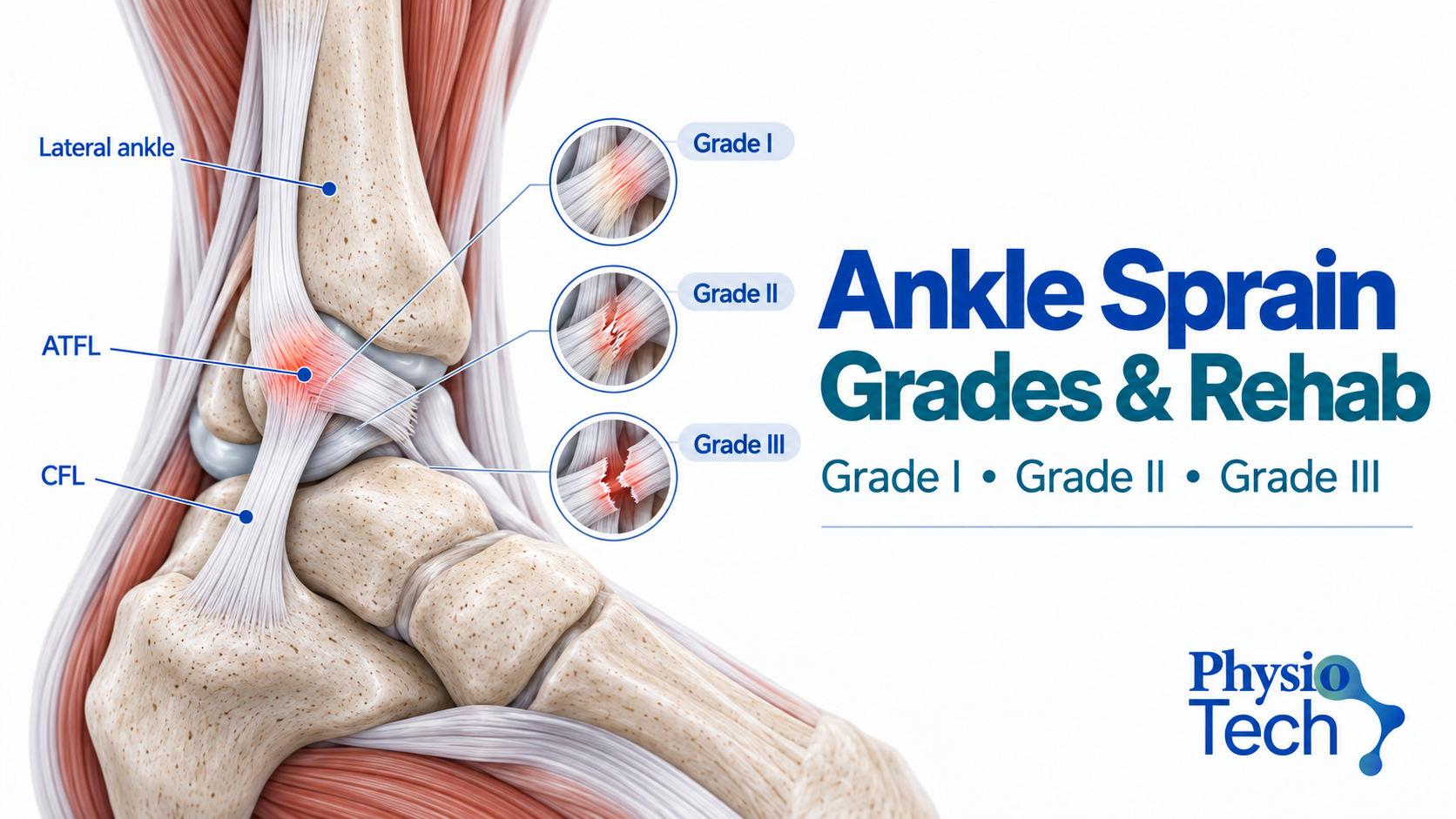
An ankle sprain occurs when one or more ligaments are stretched or torn. The most common mechanism is an inward roll of the foot, which stresses the lateral ligament complex. A less common but often more demanding injury is a high ankle sprain, which affects the syndesmosis between the tibia and fibula.
Lateral ankle sprain vs high ankle sprain
Lateral ankle sprain
Pain and swelling are usually concentrated around the outside of the ankle. This injury is common during football, basketball, running, landing, or walking on an uneven surface.
High ankle sprain
Pain is usually felt above the ankle joint and may increase when the lower leg rotates or when the patient pushes off during walking. A syndesmosis injury often needs a different assessment and may take longer to recover than a typical lateral sprain.
Common ankle sprain symptoms
• Pain after twisting the ankle
• Swelling or bruising
• Tenderness around the injured ligaments
• Difficulty bearing weight or walking normally
• Reduced ankle movement
• A feeling that the ankle is unstable or may give way
Ankle sprain grades
Grade I
A mild ligament injury with limited swelling and tenderness. Walking is usually possible, although it may be uncomfortable.
Grade II
A partial ligament tear with more noticeable pain, swelling, bruising and difficulty with weight-bearing. Physiotherapy is often important for restoring movement, strength and balance.
Grade III
A severe or complete ligament rupture with marked swelling, instability and loss of function. It requires a thorough clinical assessment to determine whether protection, imaging or specialist referral is needed.
Does an ankle sprain need an X-ray?
Not every ankle sprain needs imaging. However, a fracture should be considered when there is severe bony tenderness, visible deformity, numbness, an open wound, or an inability to take four steps after the injury. The Ottawa Ankle Rules are used by qualified clinicians to help decide when radiography is appropriate. They should not be used as a self-diagnosis tool. Seek urgent medical assessment after a significant injury if the foot becomes cold or pale, sensation changes, pain is severe or rapidly worsening, or a fracture or dislocation is suspected.
What should you do during the first few days?
• Protect the ankle: Avoid movements that sharply increase pain, but do not assume that complete rest is always necessary.
• Compression and elevation: These may help control swelling and improve comfort.
• Progressive loading: Weight-bearing is gradually increased according to symptoms and clinical findings.
• Pain relief: Ice may provide short-term pain relief for some people. Medication decisions should be discussed with a doctor or pharmacist, particularly when there are other medical conditions.
• Early assessment: The injury mechanism, ligament tenderness, ability to walk and possible fracture signs should be checked.
How physiotherapy helps an ankle sprain
Physiotherapy is not limited to reducing pain and swelling. The main goal is to restore the ankle's movement, strength, balance and ability to tolerate daily or sporting demands. A rehabilitation plan may include:
• Education and safe progression of weight-bearing
• Exercises to restore ankle dorsiflexion and mobility
• Progressive strengthening for the calf, ankle and foot muscles
• Balance, proprioception and neuromuscular control training
• Manual therapy when joint mobility is restricted
• Taping or an ankle brace when clinically appropriate
• Running, landing, cutting and sport-specific drills
• Functional testing before return to sport Electrotherapy or therapeutic ultrasound may occasionally be used as an adjunct when clinically indicated, but they do not replace progressive exercise, balance training and appropriate loading.
How long does a Grade II ankle sprain take to heal?
A Grade II ankle sprain commonly needs several weeks, but there is no single recovery date for every patient. Daily walking may improve before the ankle is ready for running, jumping or changing direction. Recovery depends on the injured ligament, swelling, pain, range of motion, strength, previous sprains and the demands of the patient's activity.
• Grade I: daily function may improve within approximately 1-2 weeks, while full activity can take longer.
• Grade II: recovery often takes approximately 3-6 weeks or more; sport-specific recovery may require additional rehabilitation.
• Grade III or high ankle sprain: recovery may take 8-12 weeks or longer and should be guided by clinical reassessment. Time alone is not a return-to-sport test. Function matters more than the calendar.
When can you return to sport?
A safe return should be based on clinical and functional criteria, including:
• Minimal pain and no significant reaction after activity
• Restored ankle movement
• Adequate calf, ankle and foot strength
• Good single-leg balance and control
• Ability to hop, land, accelerate and change direction when relevant
• Confidence in the ankle without repeated giving way
Why do ankle sprains keep recurring?
Repeated sprains are not always caused by a weak ligament alone. Reduced dorsiflexion, impaired balance, poor neuromuscular control, incomplete strength recovery and returning to sport too early can all contribute. Exercise-based rehabilitation and balance training can reduce the risk of another sprain.
When should you see a physiotherapist?
Arrange an assessment if pain or swelling is limiting walking, symptoms are not improving, the ankle repeatedly gives way, you have had several previous sprains, or you want to return safely to sport. An assessment is also useful when the diagnosis is unclear or a high ankle sprain is suspected.
Ankle sprain treatment at PhysioTech
At PhysioTech Clinic in Zahraa El Maadi, Cairo, every ankle rehabilitation programme begins with an individual clinical assessment. We examine movement, swelling, strength, balance and functional control, then build a staged plan for walking, daily activity and return to sport. Explore our physiotherapy and sports rehabilitation services or book an assessment at PhysioTech Clinic .
Scientific references
• Martin RL, et al. Lateral Ankle Ligament Sprains: Clinical Practice Guideline. JOSPT. 2021.
• Dubois B, Esculier JF. Soft-tissue injuries simply need PEACE and LOVE. BJSM. 2020.
• Stiell IG, et al. Ottawa Ankle Rules.
• Wagemans J, et al. Exercise-based rehabilitation and recurrent ankle sprain. 2022.


