Share:
53 views
#GIRD #نقص الدوران الداخلي للكتف #إصابات الرمي #ألم كتف لاعبي الكرة الطائرة #تأهيل الكتف
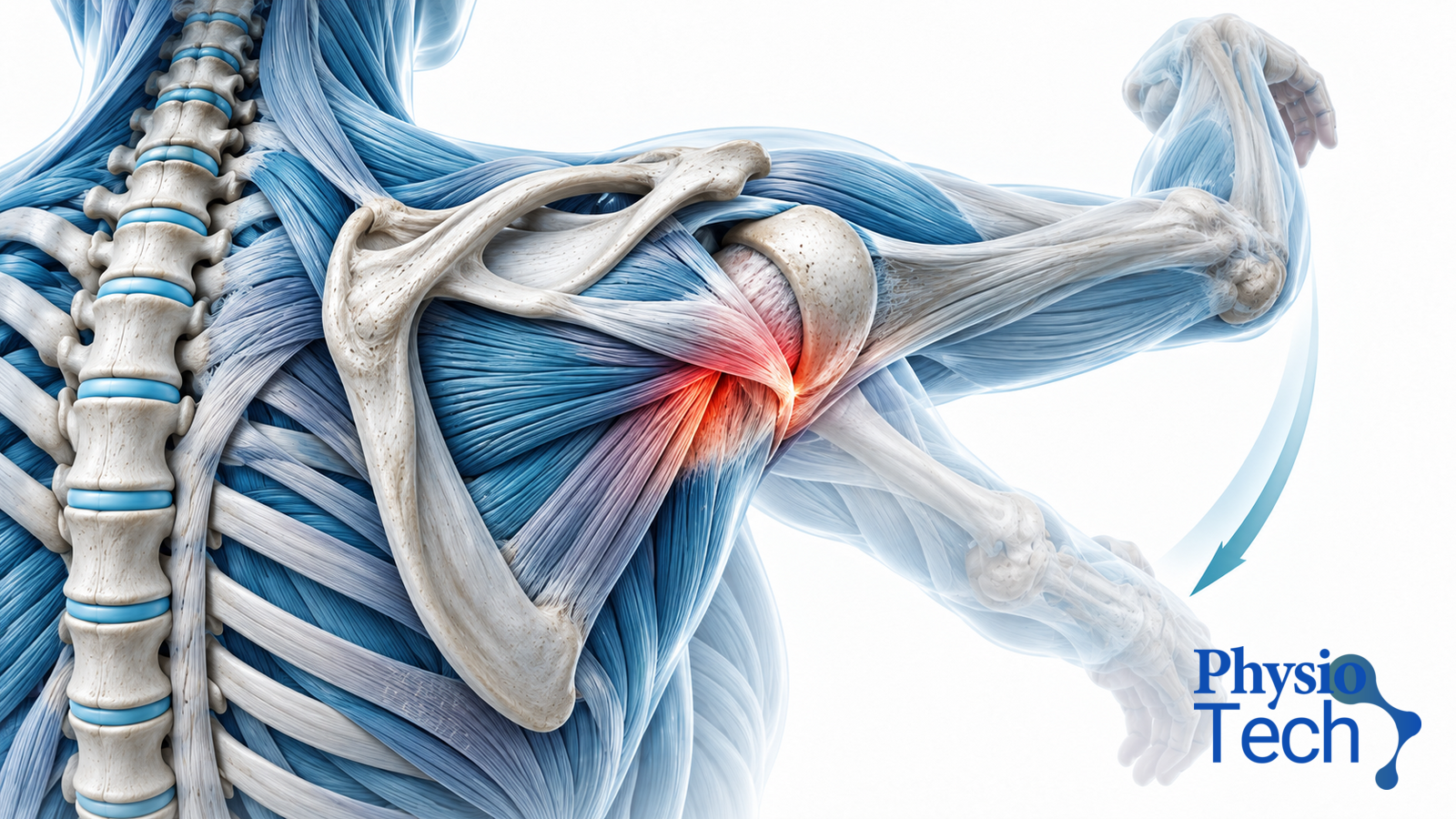
A throwing shoulder adapts over years, often gaining external rotation and losing some internal rotation. A marked loss is called GIRD, but it is not automatically disease. It matters when linked to pain, loss of total motion, weakness or inappropriate throwing load.
اقرأ المقال بالعربيةThe following information is educational and does not replace an individual examination, especially after major trauma or when warning signs are present.
What Is the Condition?
Rotation depends on bone shape, capsule and muscle. Reduced internal rotation may reflect posterior stiffness or normal bony adaptation. Comparing shoulders and the total arc is more meaningful than one internal-rotation number.
Symptoms You May Notice
• Reduced internal rotation compared with the other side.
• Posterior or anterior pain during throwing.
• A heavy arm or loss of velocity.
• Pain after a spike in throwing volume.
• Difficulty reaching behind the back in some cases.
Causes and Contributing Factors
Throwing volume, fatigue, cuff and scapular capacity, posterior stiffness and adaptation may interact. Not every asymmetry needs aggressive stretching.
Conditions That Can Look Similar
SLAP injury, cuff tendinopathy, internal impingement, shoulder instability, suprascapular neuropathy and cervical referral.
How Is It Assessed at PhysioTech?
Rotation is measured with the scapula controlled and total arc calculated. Cuff and scapular strength and the trunk and hip kinetic chain are examined, alongside workload and the painful phase of throwing.
What Do We Measure?
Internal and external rotation and total arc, rotational strength ratios, throwing capacity, available velocity or accuracy measures and next-day response.
We record a meaningful task such as walking, running, stairs or reaching, the response during it and what happens later and the next day. Movement, strength, capacity and task quality are compared over time rather than judging progress only by short-term relief in the session.
When May Imaging or Medical Referral Be Needed?
A pop with acute pain, sudden weakness, dislocation, persistent numbness or progressive performance loss despite load adjustment needs medical assessment and possible imaging.
Imaging is not required for every patient. It becomes important after major trauma, with warning signs, when progress is unexpectedly poor, or when the result would change loading, referral or surgical decisions. Imaging decisions are coordinated with the appropriate physician.
GIRD in Overhead Athletes Treatment at PhysioTech
1. Protect the Area and Manage Load
Temporarily reduce throwing volume or intensity when linked to symptoms while maintaining suitable conditioning.
2. Restore Movement and Control
Use measured posterior-shoulder mobility such as cross-body work when indicated without forcing the joint or ignoring scapular contribution.
3. Build Strength and Capacity
Build cuff, scapular, trunk and hip strength with tolerance for high-speed work because throwing uses the full kinetic chain.
4. Return to Activity or Sport
Return with a throwing programme that progresses distance, volume and intensity, includes recovery days and tracks pain, accuracy and velocity.
A central part of care is understanding why each exercise was chosen and how to adjust the dose. We agree on an acceptable symptom response, then progress repetitions, resistance, speed or task complexity. We do not promise a fixed recovery date because injury severity, general health and activity demands vary.
The PhysioTech Treatment Philosophy in Cairo
At PhysioTech Clinic in Zahraa El Maadi, Cairo, care starts with assessment rather than an imaging label alone. We connect symptom behaviour with movement, strength, capacity and work or sport demands, record clear baseline measures and retest them. Manual therapy, dry needling, kinesio taping, electrotherapy or therapeutic ultrasound may be used for a defined purpose, but they do not replace education, therapeutic exercise and graded loading.
Perfect symmetry is not the goal for every thrower. Useful adaptation is preserved while symptom-related motion loss, weakness and workload are addressed.
Red Flags That Need Prompt Medical Review
Dislocation or deformity, sudden marked weakness, persistent numbness or sensory loss, escalating severe night pain or acute inability to throw.
Frequently Asked Questions
Does every rotation loss need treatment?
No. It can be normal adaptation; symptoms, total arc, strength and workload determine relevance.
Is the sleeper stretch essential?
No. It can irritate some shoulders and is selected only when examination supports it.
When can throwing restart?
After symptoms and strength improve and a graded throwing programme can be completed.
When Should You Book an Assessment?
If throwing performance drops or pain appears with motion loss, book an overhead-athlete shoulder assessment at PhysioTech in Zahraa El Maadi, Cairo.
Trusted References
• pmc.ncbi.nlm.nih.gov