Share:
88 views
#الجنف #انحناء العمود الفقري #تمارين الجنف #Scoliosis #علاج طبيعي
Scoliosis Physiotherapy: Can Exercise Fix the Curve?
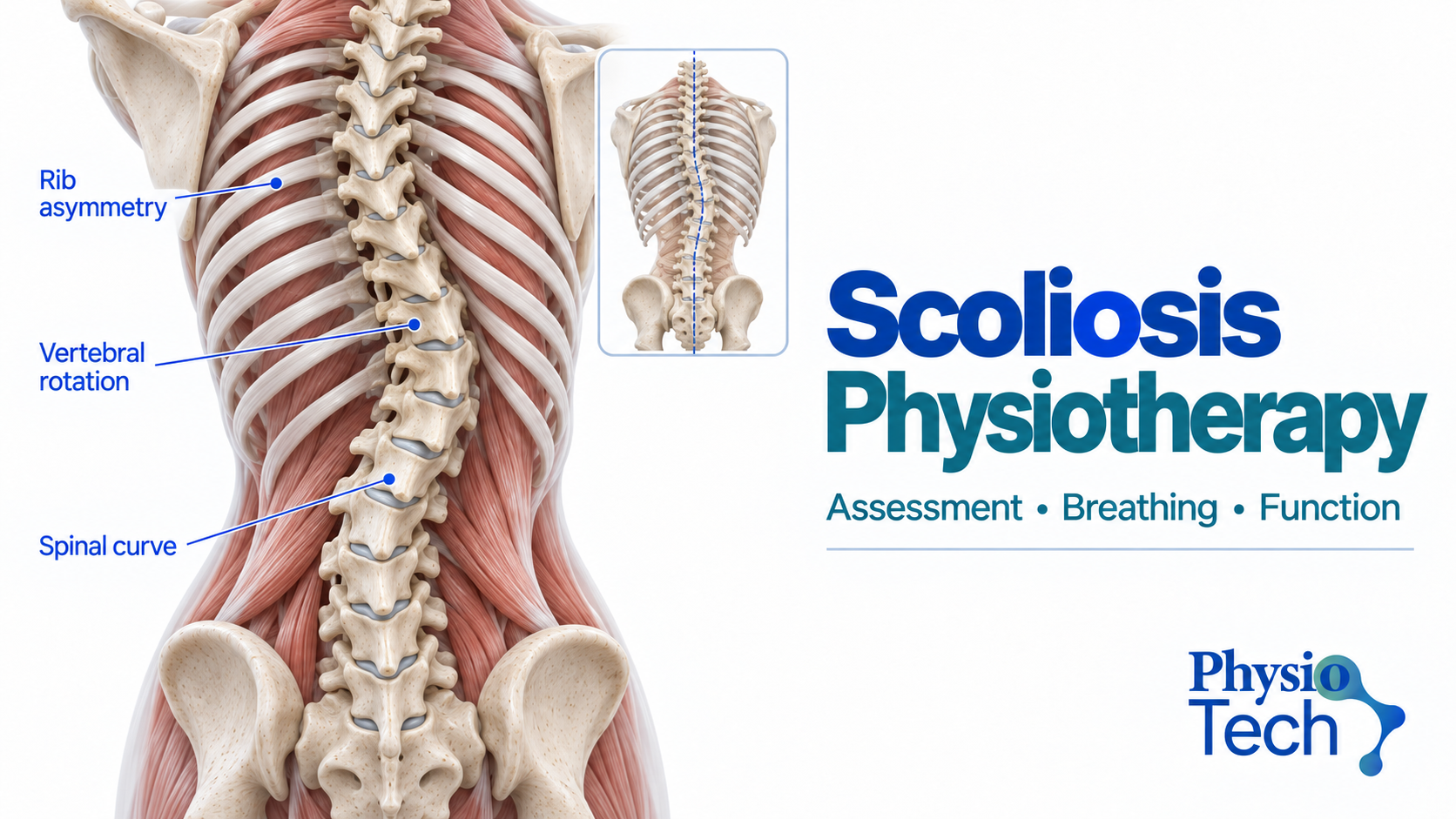
اقرأ المقال بالعربيةScoliosis is a three-dimensional spinal deformity, not only a sideways bend. Vertebral rotation and asymmetry of the shoulders or rib cage may occur. The curve is commonly measured with the Cobb angle on X-ray, but age, remaining growth, progression, symptoms and overall balance also guide management.
Can physiotherapy straighten every spine?
No clinician should promise that exercise will make every curve disappear. In growing children and adolescents, physiotherapeutic scoliosis-specific exercises may improve postural control, breathing and quality of life and can form part of a plan intended to limit progression in selected curves. In adults, treatment commonly focuses on pain, fitness, balance, work and daily function while the structural curve may remain.
Structural scoliosis versus postural asymmetry
Structural scoliosis includes a relatively fixed curve and vertebral rotation. A flexible lean can also occur with leg-length difference, pain or habitual posture. Examination and imaging when indicated distinguish them. A photograph or phone application is not enough for diagnosis.
What are scoliosis-specific exercises?
Physiotherapeutic scoliosis-specific exercises are individualized to the curve pattern. They may include active self-elongation, three-dimensional correction, directed breathing and maintaining the corrected position during sitting, walking and daily tasks. One generic exercise list cannot suit every curve direction.
When is bracing needed?
A spine specialist may recommend a brace for selected growing adolescents whose curves are at risk of progression. Success depends on selection, design, adherence and prescribed wearing time. Physiotherapy does not replace a brace when it is indicated, but it can support movement, breathing, strength and adherence.
When is surgery discussed?
Surgery is considered for some large or progressive curves or major functional problems. The specialist balances age, growth, curve magnitude, symptoms and health impact. Regular monitoring remains important.
Adult scoliosis
Adult scoliosis may persist from adolescence or develop with degenerative change. Physiotherapy builds trunk and hip capacity, endurance and balance and helps modify activity loads. The goal is improved participation, not maintaining one “perfect posture” all day.
PhysioTech assessment
At PhysioTech in Zahraa El Maadi, Cairo, we review history, imaging and reports and assess posture, movement, breathing, strength, balance and neurological symptoms. Exercise is matched to curve direction and patient goals with measurable follow-up. Manual therapy or kinesio taping may help selected symptoms but cannot correct a structural curve alone.
Seek medical review for severe unusual night pain, fever or weight loss, worsening numbness or weakness, gait disturbance, or bladder or bowel change. A child with rapidly increasing asymmetry during growth also needs specialist review.
This article is educational and does not replace medical examination or imaging follow-up.