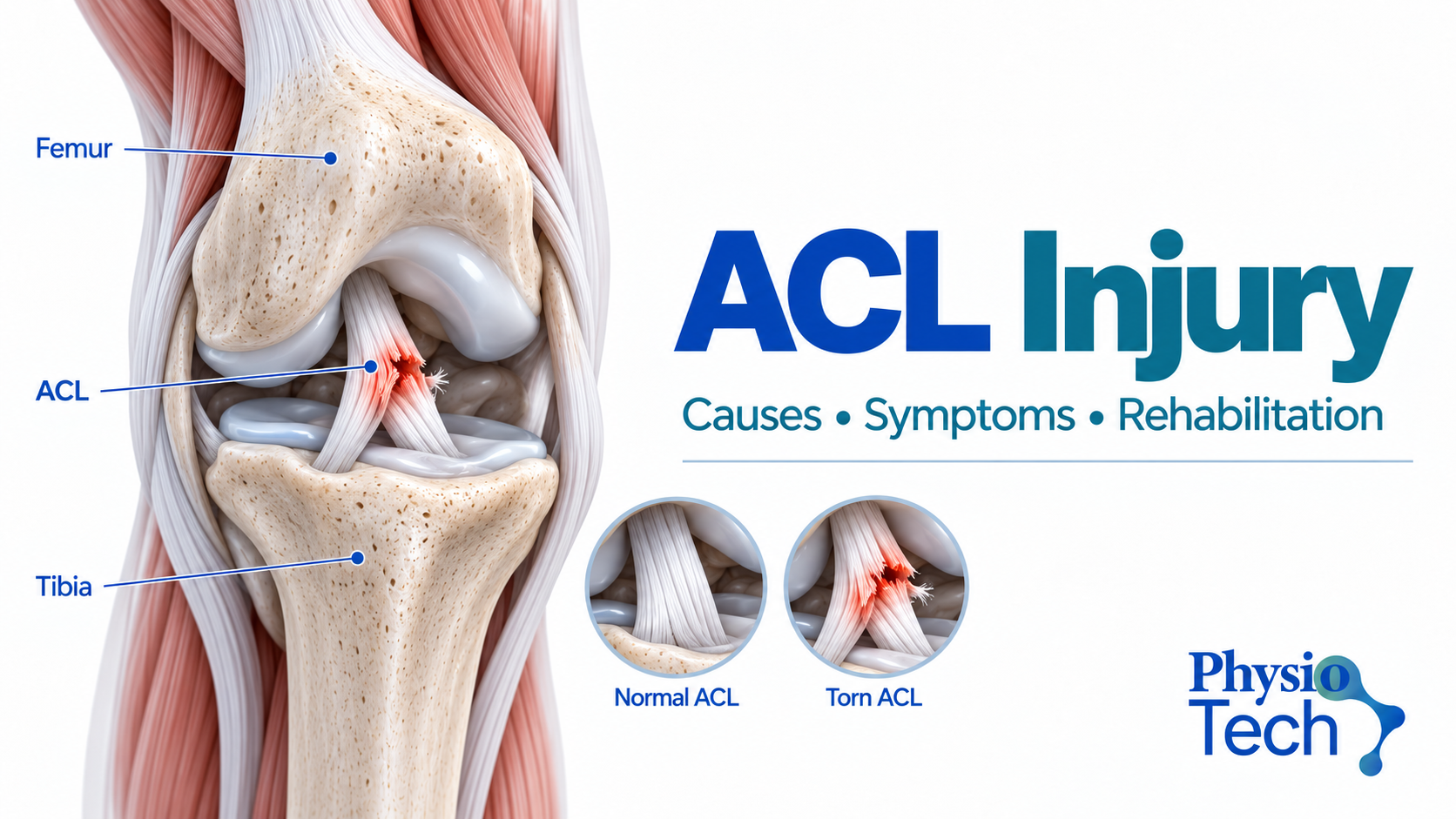
What is an ACL injury?
The anterior cruciate ligament (ACL) is one of the main structures that helps control knee stability during running, landing, and changes of direction. Injury can range from a partial sprain to a complete tear and may occur alone or with meniscus or other ligament damage.
How does an ACL injury happen?
Many ACL injuries are non-contact injuries caused by rapid cutting, sudden deceleration, or landing with poor control of the knee and trunk. The ligament can also be injured through a collision or direct blow to the knee.
Common symptoms
• A pop or sudden sensation at the time of injury.
• Rapid swelling during the first hours.
• Pain and difficulty bearing weight or bending the knee.
• A feeling that the knee gives way.
• Loss of motion, especially full knee extension.
These findings do not confirm an ACL tear by themselves. Meniscus injuries, bone bruises, and other ligament injuries can cause a similar presentation.
How is an ACL injury diagnosed?
Diagnosis begins with the injury history and a clinical examination of swelling, range of motion, walking, and knee stability. Tests may include Lachman, anterior drawer, and pivot shift when symptoms allow. X-rays may be requested to exclude fracture. MRI helps assess the ACL and associated injuries, but treatment decisions should combine imaging with clinical findings, function, and the patient’s goals.
Does every ACL tear require surgery?
No. The decision between rehabilitation without surgery and ACL reconstruction depends on recurrent instability, associated injuries, occupational and sporting demands, and individual goals. Some people regain adequate function through structured rehabilitation. Surgery may be discussed when instability persists, when associated injuries require intervention, or when the goal is to return to pivoting and cutting sports.
Physiotherapy before surgery
When surgery is planned, pre-operative rehabilitation aims to reduce swelling, restore full extension and useful flexion, improve quadriceps activation, and normalize walking. Entering surgery with a stiff and swollen knee may make early rehabilitation more difficult.
Rehabilitation after ACL reconstruction
ACL rehabilitation should progress by criteria, not by time alone.
Early phase
• Control pain and swelling.
• Restore full knee extension and the permitted flexion range.
• Reactivate the quadriceps and improve walking.
• Follow the surgeon’s restrictions when a meniscus repair or another procedure was performed.
Strength and movement-control phase
• Develop quadriceps, hamstring, hip, and calf strength.
• Improve balance and neuromuscular control.
• Progress load according to symptoms and objective measures.
• Compare both limbs instead of relying only on how the knee feels.
Running and return to sport
Running begins when appropriate motion, strength, control, and symptom criteria are met—not simply when a certain month is reached. Return to sport requires strength, hop and movement-quality testing, psychological readiness, and the ability to perform sport-specific tasks without increasing pain or swelling. Returning before these criteria are met may increase reinjury risk.
How PhysioTech manages ACL rehabilitation
At PhysioTech in Zahraa El Maadi, Cairo, ACL care starts with an individual assessment of swelling, motion, strength, walking, and movement control. The plan may include therapeutic exercise, neuromuscular training, graded loading, and manual therapy when indicated, with regular reassessment and coordination with the surgeon after reconstruction.
There is no single protocol for everyone. Progression depends on the injury or surgical stage, associated procedures, the knee’s response, and the patient’s goal—from comfortable daily activity to competitive sport.
When should you seek urgent assessment?
Seek prompt medical assessment for obvious deformity, inability to bear weight, a fully locked knee, severe rapid swelling after major trauma, calf pain or swelling, or shortness of breath. After surgery, contact the medical team for increasing fever, redness, or wound discharge.
Book an ACL assessment at PhysioTech
If you have knee pain or instability after an injury, are preparing for ACL surgery, or are recovering after reconstruction, you can book an assessment at PhysioTech in Zahraa El Maadi. Assessment defines your current function, goals, and next step without promising a fixed number of sessions or a recovery date before examination.