Share:
37 views
#كسر إجهادي بعنق الفخذ #Femoral neck stress fracture #ألم الفخذ عند الجري #إصابات الجري #تأهيل رياضي
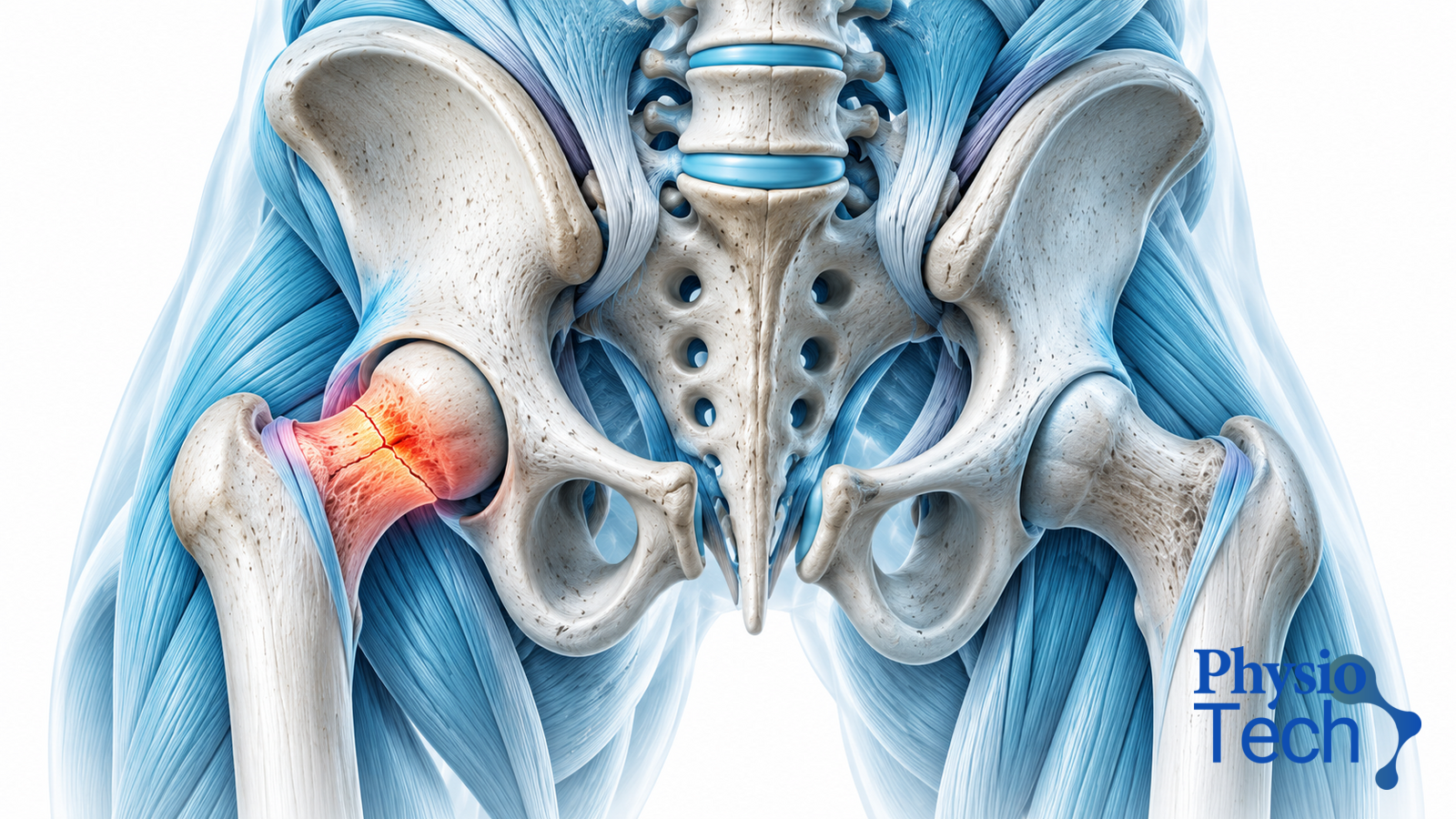
Deep groin pain that worsens with running or hopping and begins to affect walking should raise concern for a femoral-neck bone stress injury. This is a high-risk site because continued loading can progress a stress reaction to a complete or displaced fracture.
اقرأ المقال بالعربيةThe following information is educational and does not replace an individual examination, especially after major trauma or when warning signs are present.
What Is the Condition?
The femoral neck bridges the head and shaft and carries high forces during running. Bone stress develops when repeated load outpaces repair. Early plain radiographs may be normal, while MRI is more sensitive when suspicion remains high.
Symptoms You May Notice
• Deep groin or anterior-thigh pain during running.
• Pain with hopping or single-leg loading.
• Progression to pain during walking or rest.
• Limping or sudden loss of training tolerance.
• Night pain in more advanced presentations.
Causes and Contributing Factors
A rapid increase in distance or speed, limited recovery, low energy availability, menstrual disruption, reduced bone health, previous stress injury, or surface and footwear changes may interact. This is not simply a weak muscle.
Conditions That Can Look Similar
Adductor or iliopsoas pain, hip impingement, labral injury, pubic-related pain and lumbar referred pain.
How Is It Assessed at PhysioTech?
When suspected, painful hopping is not repeatedly tested. Training progression, nutrition, menstrual health and bone health are reviewed, gait and movement are examined cautiously, and rapid medical referral and imaging are arranged.
What Do We Measure?
After loading is cleared we track pain-free walking, hip motion and strength, single-leg tolerance and progression from low-impact conditioning toward criterion-based running.
We record a meaningful task such as walking, running, stairs or reaching, the response during it and what happens later and the next day. Movement, strength, capacity and task quality are compared over time rather than judging progress only by short-term relief in the session.
When May Imaging or Medical Referral Be Needed?
Groin pain with limping, rest or night pain, or inability to bear weight requires running to stop and urgent medical assessment. An early negative X-ray does not exclude the diagnosis.
Imaging is not required for every patient. It becomes important after major trauma, with warning signs, when progress is unexpectedly poor, or when the result would change loading, referral or surgical decisions. Imaging decisions are coordinated with the appropriate physician.
Femoral Neck Bone Stress Injury Treatment at PhysioTech
1. Protect the Area and Manage Load
Protection comes first: stop running, jumping and painful loading and follow medical instructions for crutches and weight bearing. Do not repeatedly provoke pain to test the bone.
2. Restore Movement and Control
After healing or medical clearance, restore hip movement and gait gradually and address nutrition and bone-health factors with the wider clinical team.
3. Build Strength and Capacity
Build hip, trunk and calf strength using low-impact conditioning before impact is reintroduced against safety criteria.
4. Return to Activity or Sport
Return to running starts with short walk-run doses, increases volume before speed, and monitors symptoms during, later and the next day.
A central part of care is understanding why each exercise was chosen and how to adjust the dose. We agree on an acceptable symptom response, then progress repetitions, resistance, speed or task complexity. We do not promise a fixed recovery date because injury severity, general health and activity demands vary.
The PhysioTech Treatment Philosophy in Cairo
At PhysioTech Clinic in Zahraa El Maadi, Cairo, care starts with assessment rather than an imaging label alone. We connect symptom behaviour with movement, strength, capacity and work or sport demands, record clear baseline measures and retest them. Manual therapy, dry needling, kinesio taping, electrotherapy or therapeutic ultrasound may be used for a defined purpose, but they do not replace education, therapeutic exercise and graded loading.
The priority is not keeping an athlete in training at any cost. It is preventing a more serious fracture and rebuilding bone health and capacity before return.
Red Flags That Need Prompt Medical Review
Sudden severe pain or a pop, inability to bear weight, increasing limp, rest or night pain, or systemic symptoms needs urgent assessment.
Frequently Asked Questions
Is a plain X-ray enough?
It may be normal early; the physician decides whether MRI or other tests are required.
Can I run if pain is tolerable?
Not when this injury is suspected, because continued testing can increase risk.
Do exercises heal the bone?
Rehabilitation follows protection and restores strength and loading while contributing factors are managed medically.
When Should You Book an Assessment?
If deep groin pain and limping develop with running, stop running and seek medical assessment; rehabilitation can then be coordinated at PhysioTech in Cairo.
Trusted References
• pmc.ncbi.nlm.nih.gov
• journals.sagepub.com