Share:
144 views
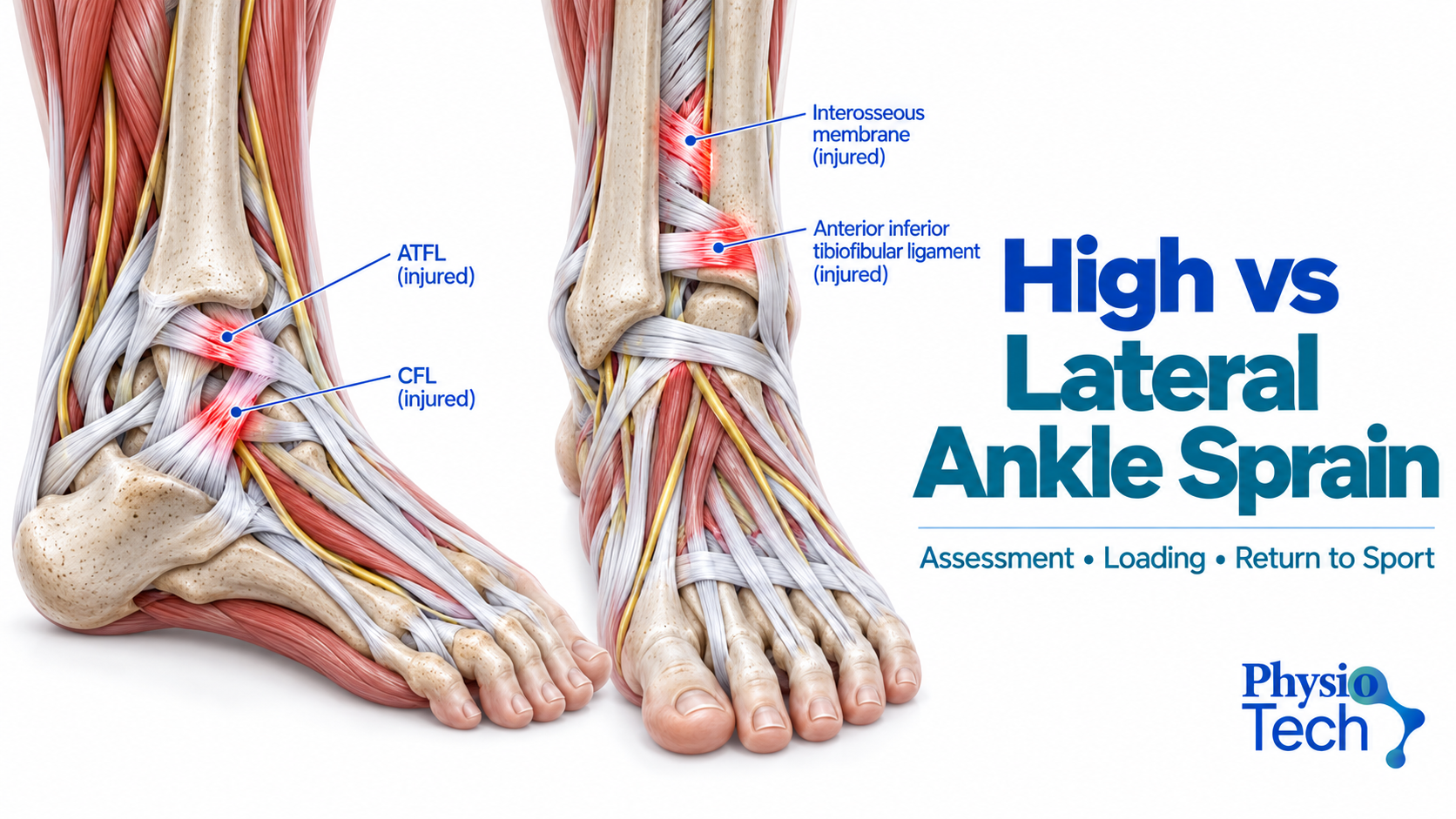
A lateral ankle sprain is common, but it differs from a high ankle sprain, which affects the syndesmotic ligaments connecting the tibia and fibula above the ankle. Correct identification matters because the mechanism, pain location, weight-bearing tolerance and return-to-sport progression may differ.
اقرأ المقال بالعربيةLateral ankle sprain
This commonly involves the anterior talofibular ligament (ATFL) and sometimes the calcaneofibular ligament (CFL). It often occurs when the foot rolls inward during landing or a change of direction. Symptoms include pain and swelling around the outside of the ankle, difficulty walking or running, and sometimes instability.
High ankle sprain
A syndesmotic sprain affects the ligaments between the tibia and fibula. It often follows external rotation of the foot or body rotation over a planted foot. Pain is usually above the ankle joint and may increase during push-off, running or rotation. Recovery can be longer than for a lateral sprain, but timing depends on stability, severity and sporting demands.
Assessment
Assessment considers the mechanism, pain location, swelling, weight-bearing, movement, strength and stability. Specific tests examine each ligament group, but no single test should decide the diagnosis. X-rays may be indicated for focal bone tenderness or inability to walk. Suspected unstable syndesmotic injury may require medical assessment and further imaging.
Rehabilitation stages
1. Protection and symptom control
Protect injured tissue, reduce swelling and maintain safe movement. A brace or walking aid may be appropriate. Loading progresses according to stability and symptoms.
2. Restore movement and strength
Mobility, foot and lower-leg strength, calf capacity and graded weight-bearing are developed. Syndesmotic injury may require more cautious progress.
3. Balance and neuromuscular control
Single-leg balance, perturbation work, landing mechanics and change-of-direction control reduce recurrence risk.
4. Running and sport progression
Rehabilitation advances from brisk walking to running, hopping, landing, acceleration and cutting. Calendar time alone is not a return-to-play test.
Return-to-sport criteria
Pain and swelling, ankle motion, calf strength, balance, hopping, agility and confidence should be considered. The athlete should tolerate sport-specific training without a meaningful next-day flare.
PhysioTech rehabilitation
Our programme matches the injured ligament, joint stability and target sport. It may include manual therapy, exercise therapy and functional training, with kinesiology taping, electrotherapy or therapeutic ultrasound used selectively. Progressive loading and restored performance remain the foundation.
When to seek prompt review
Seek assessment for deformity, severe focal bone pain, inability to bear weight, foot numbness or coldness, pain above the ankle after strong rotation, or persistent swelling without improvement.
The type of sprain and safe return date cannot be determined accurately without examination.
The PhysioTech Ankle Rehabilitation Plan
At PhysioTech Clinic in Zahraa El Maadi, Cairo, we connect mechanism and symptoms with motion, strength, stability, balance and weight-bearing tolerance. Suspected syndesmotic instability or focal bone pain needs medical review before progression.
A Measurable Individual Plan
Ankle motion, calf-raise capacity, balance and walking provide baselines. Protection is selected according to stability; exercise therapy progresses toward hopping, running and change of direction.
Manual Therapy and Adjuncts
Manual therapy may support motion when appropriate. Kinesio taping or electrotherapy may serve defined short-term goals, but do not replace assessment, exercise therapy or graded loading.
Reassessment and Return to Sport
Strength, balance, agility, confidence and next-day response are retested. High ankle injuries may need more cautious progression. Return requires tolerance of sport-specific training without meaningful next-day pain or swelling.
Book an individual assessment at PhysioTech Clinic in Zahraa El Maadi, Cairo, to agree goals based on your examination.