Share:
117 views
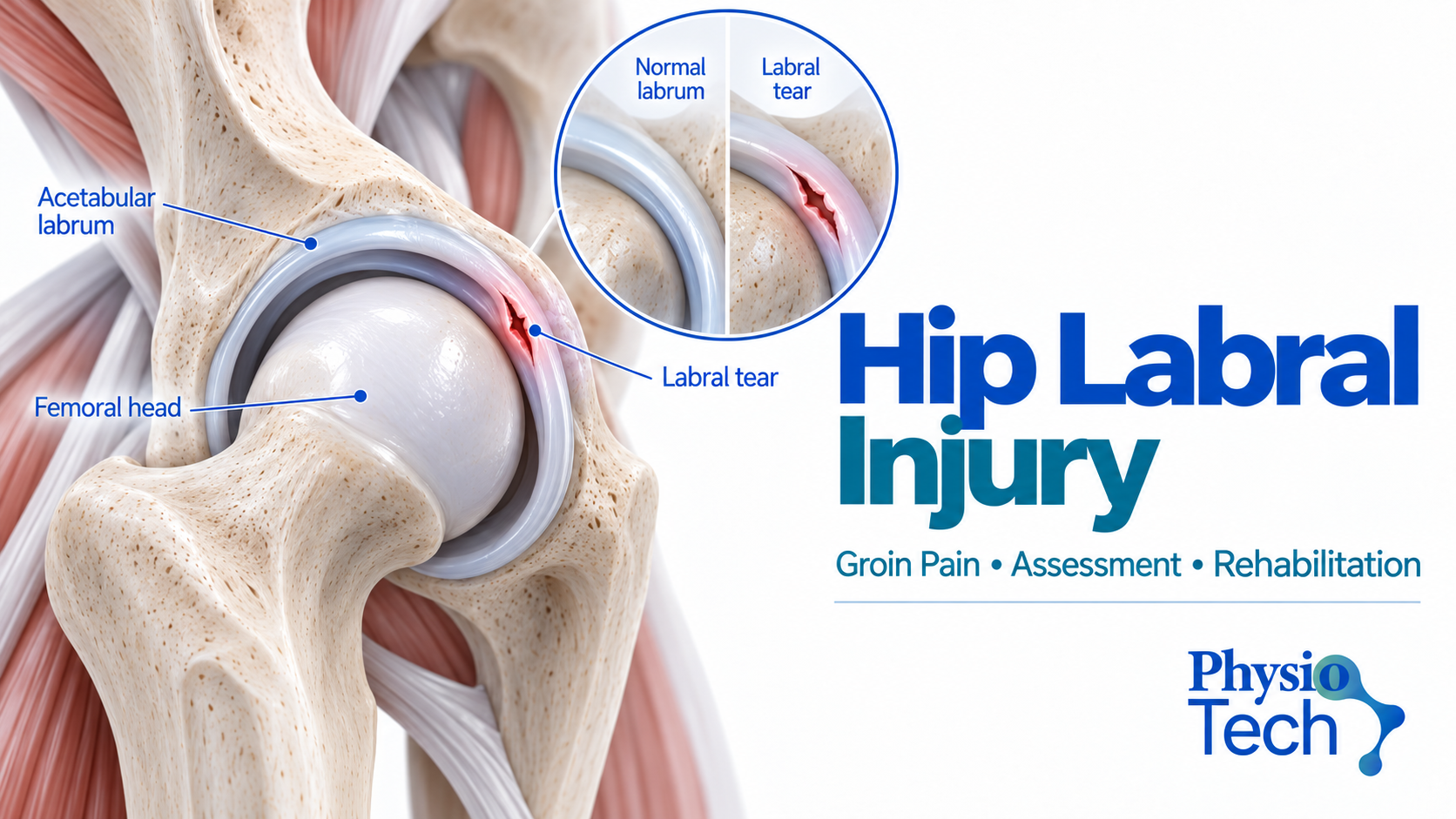
The hip labrum is a fibrocartilage ring around the socket that supports stability and load distribution. It can tear or change with repeated flexion and rotation, yet a tear on imaging is not always the source of pain.
اقرأ المقال بالعربيةPossible symptoms
Deep groin or anterior hip pain, discomfort in low sitting or squatting, painful clicking or catching, reduced motion, and difficulty running or kicking may occur. Painless clicking is common, while tendons, muscles and the lumbar spine can mimic joint pain.
Causes and associated factors
Symptoms may be related to femoroacetabular impingement, anatomical variation, sports injury or repeated load above current capacity. Bone shape alone is not a disease; similar findings occur in symptom-free people.
Assessment at PhysioTech
We review training load, pain location, hip motion and strength, pelvic control and functional tasks such as squatting, landing and cutting. Joint tests are interpreted alongside lumbar and tendon assessment.
A doctor may request X-ray or MRI when symptoms persist or a medical decision is needed. Imaging must be matched with examination and goals.
Non-surgical physiotherapy
Management may include temporary modification of provocative loads, comfortable mobility, progressive strengthening of the gluteal, adductor and trunk muscles, movement control in squatting and running, and criteria-based return to sport. Manual therapy can support pain and movement in selected cases, but passive methods do not replace capacity building.
When surgery is considered
Hip arthroscopy may be discussed when meaningful symptoms persist despite high-quality conservative care and the history, examination and imaging agree. MRI alone should not decide surgery, and structured rehabilitation is still required afterward.
Return to sport
Clearance is not based only on time. Hip motion, multidirectional strength, single-leg control, hopping, landing, running and sport-specific skills should be tested while monitoring the next-day response.
Seek prompt assessment after major trauma, inability to bear weight, true joint locking, fever, unusual night pain or unexplained weight loss.
PhysioTech connects objective assessment to each patient's work or sport goals.
Educational content only; it does not replace diagnosis.
How PhysioTech Manages a Hip Labral Injury
At PhysioTech Clinic in Zahraa El Maadi, Cairo, we connect symptoms with hip and lumbar examination, pelvic strength and meaningful tasks. MRI findings alone do not prove the pain source.
A Measurable Baseline
Hip motion, gluteal and adductor strength and single-leg control are recorded alongside sitting, stairs, running or kicking.
Exercise Therapy and Graded Loading
Resistance, range and task speed progress according to irritability, capacity and next-day response. Provocative loads may be modified temporarily and rebuilt.
Manual Therapy and Safe Return
Manual therapy may support movement or exercise tolerance for a defined short-term purpose. It does not replace assessment, exercise therapy or graded loading. Strength, running, landing and sport skills are retested before return.
Book an individual assessment at PhysioTech Clinic in Zahraa El Maadi, Cairo, to review likely contributors and agree measurable goals based on your examination.