Share:
30 views
#عدم ثبات مفصل الفخذ #Hip microinstability #ألم مفصل الفخذ #إصابات الراقصين #تأهيل رياضي
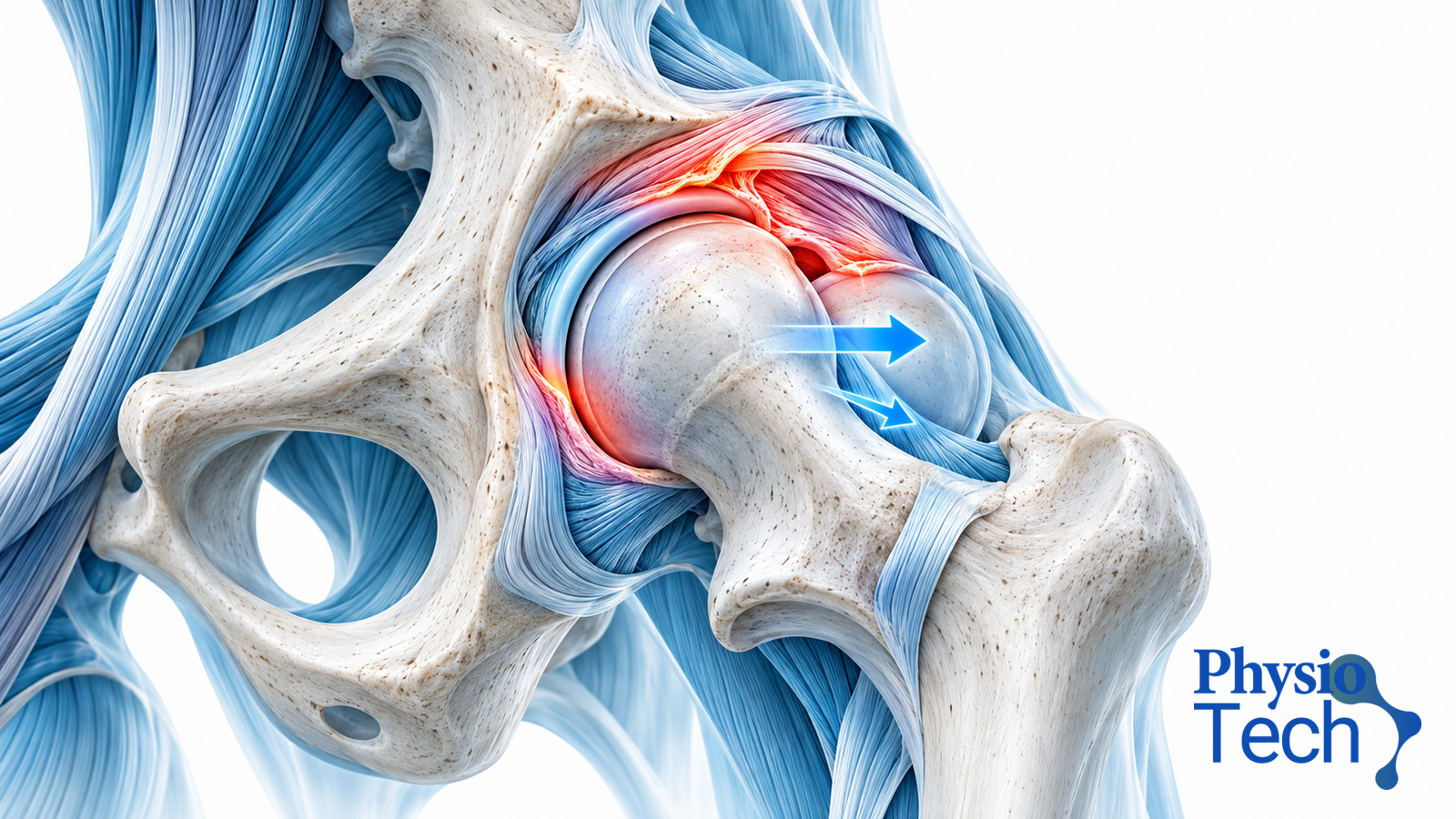
Hip microinstability does not mean the joint is dislocated. It describes small excessive motion that becomes painful or feels insecure, and may occur in some athletes and dancers, people with generalised laxity, or those with capsular and bony factors.
The following information is educational and does not replace an individual examination, especially after major trauma or when warning signs are present.
What Is the Condition?
Hip stability comes from acetabular and femoral shape, the labrum, capsule and ligaments, and the surrounding muscles. When these systems do not control motion under load, symptoms can occur even though standard imaging shows no dislocation.
Symptoms You May Notice
• Deep anterior hip or groin pain.
• A sense of insecurity near end-range positions.
• Clicking or fatigue with dance, running or single-leg work.
• Pain during repeated extension and external rotation.
• Improvement with rest and recurrence under high demand.
Causes and Contributing Factors
Generalised laxity, end-range sports, capsular or labral injury, reduced acetabular coverage and limited muscular control may interact. No single test or flexibility finding confirms the diagnosis.
Conditions That Can Look Similar
Hip impingement, labral injury, iliopsoas-related pain, greater trochanteric pain syndrome, hip osteoarthritis and lumbar referred pain.
How Is It Assessed at PhysioTech?
History is combined with generalised laxity, hip motion, strength and single-leg control. Provocative tests are interpreted as a group. Diagnosis may require review by a hip specialist and appropriate imaging.
What Do We Measure?
Gluteal and rotational strength, squat and landing control, single-leg tolerance, symptoms in defined positions and sport movements performed without instability.
We record a meaningful task such as walking, running, stairs or reaching, the response during it and what happens later and the next day. Movement, strength, capacity and task quality are compared over time rather than judging progress only by short-term relief in the session.
When May Imaging or Medical Referral Be Needed?
Inability to bear weight after trauma, true locking, worsening night pain or failure of well-delivered conservative care needs medical review. Suspected dysplasia or substantial labral injury may require specialist imaging.
Imaging is not required for every patient. It becomes important after major trauma, with warning signs, when progress is unexpectedly poor, or when the result would change loading, referral or surgical decisions. Imaging decisions are coordinated with the appropriate physician.
Hip Microinstability Treatment at PhysioTech
1. Protect the Area and Manage Load
Temporarily reduce repeated end-range positions and movements that provoke instability while maintaining controlled activity.
2. Restore Movement and Control
Train mid-range control of the pelvis and trunk, using the necessary hip range without repeatedly hanging on uncontrolled end range.
3. Build Strength and Capacity
Progress gluteal, rotational and trunk strength toward single-leg stance, cutting and landing under increasing load.
4. Return to Activity or Sport
Return to dance or sport by adding range, speed and fatigue gradually, testing movement quality and confidence before full performance.
A central part of care is understanding why each exercise was chosen and how to adjust the dose. We agree on an acceptable symptom response, then progress repetitions, resistance, speed or task complexity. We do not promise a fixed recovery date because injury severity, general health and activity demands vary.
The PhysioTech Treatment Philosophy in Cairo
At PhysioTech Clinic in Zahraa El Maadi, Cairo, care starts with assessment rather than an imaging label alone. We connect symptom behaviour with movement, strength, capacity and work or sport demands, record clear baseline measures and retest them. Manual therapy, dry needling, kinesio taping, electrotherapy or therapeutic ultrasound may be used for a defined purpose, but they do not replace education, therapeutic exercise and graded loading.
The aim is not to make a flexible person rigid. It is to own the available range under load while recognising cases that need specialist surgical opinion.
Red Flags That Need Prompt Medical Review
Post-traumatic deformity or inability to bear weight, fixed locking, increasing sensory loss or weakness, heat with fever, or unusual night pain.
Frequently Asked Questions
Is microinstability the same as recurrent dislocation?
No. It refers to small symptomatic motion rather than a complete dislocation.
Must flexibility be stopped?
No, but painful end range may be reduced temporarily while strength and control are built.
Do exercises work for every case?
Many improve with rehabilitation, while major bony or labral factors may need specialist opinion.
When Should You Book an Assessment?
If hip pain includes a sense of instability during sport or dance, book an assessment at PhysioTech in Zahraa El Maadi, Cairo.
Trusted References
• d-nb.info