Share:
29 views
#إصابة ليسفرانك #Lisfranc injury #ألم منتصف القدم #تأهيل بعد جراحة القدم #إصابات الملاعب
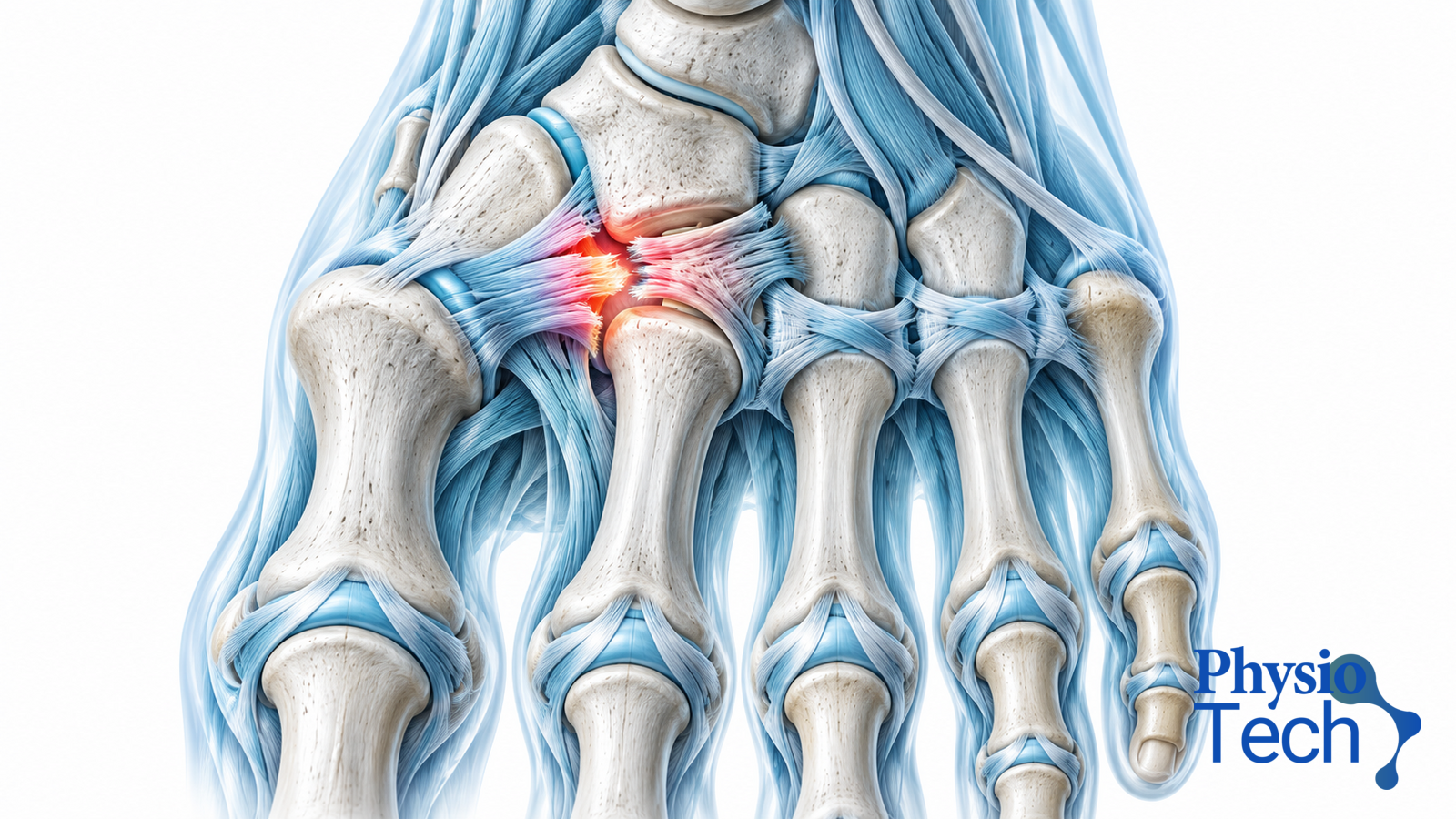
A Lisfranc injury affects the ligaments, bones or joints of the midfoot. It can follow a twist on a flexed foot, a crush or a sports injury. Some cases resemble a simple sprain yet cause marked pain during weight bearing and push-off.
اقرأ المقال بالعربيةThe following information is educational and does not replace an individual examination, especially after major trauma or when warning signs are present.
What Is the Condition?
The Lisfranc complex connects the metatarsal bases to the cuneiforms and cuboid and stabilises the midfoot arch. Ligament disruption, fracture or dislocation may create instability that requires fixation or fusion.
Symptoms You May Notice
• Midfoot pain and swelling.
• Bruising on the sole, an important clue.
• Marked pain with weight bearing or push-off.
• Widening or deformity in severe injury.
• Persistent pain after a diagnosis of a simple sprain.
Causes and Contributing Factors
Injury can result from high energy or a low-energy sports twist. Foot position, force and direction determine the damage; pain intensity alone cannot define stability.
Conditions That Can Look Similar
Ankle sprain, metatarsal fracture, foot-tendon injury, simple contusion and talonavicular injury.
How Is It Assessed at PhysioTech?
Swelling, plantar bruising and pain location are examined, but provocative weight-bearing tests are not repeatedly forced when suspicion is high. Weight-bearing radiographs, CT or MRI may be selected medically.
What Do We Measure?
After healing is stable, permitted weight bearing, gait, ankle and foot motion, midfoot swelling, calf and foot strength, and later hopping, propulsion and cutting are tracked.
We record a meaningful task such as walking, running, stairs or reaching, the response during it and what happens later and the next day. Movement, strength, capacity and task quality are compared over time rather than judging progress only by short-term relief in the session.
When May Imaging or Medical Referral Be Needed?
Plantar bruising with midfoot pain, deformity, inability to bear weight or persistent symptoms after a twist needs prompt medical review; delayed diagnosis can harm the joint.
Imaging is not required for every patient. It becomes important after major trauma, with warning signs, when progress is unexpectedly poor, or when the result would change loading, referral or surgical decisions. Imaging decisions are coordinated with the appropriate physician.
Lisfranc Injury Treatment at PhysioTech
1. Protect the Area and Manage Load
Follow non-weight-bearing, boot and surgeon instructions, train safe crutch use and maintain limb capacity without stressing the midfoot.
2. Restore Movement and Control
After clearance, progress weight bearing and restore ankle and toe movement and gait without forcing painful midfoot motion.
3. Build Strength and Capacity
Build foot, calf and hip strength from supported heel raise toward single-leg propulsion.
4. Return to Activity or Sport
Return to running, hopping and cutting after imaging stability, strength and control criteria; footwear or orthoses may be adjusted individually.
A central part of care is understanding why each exercise was chosen and how to adjust the dose. We agree on an acceptable symptom response, then progress repetitions, resistance, speed or task complexity. We do not promise a fixed recovery date because injury severity, general health and activity demands vary.
The PhysioTech Treatment Philosophy in Cairo
At PhysioTech Clinic in Zahraa El Maadi, Cairo, care starts with assessment rather than an imaging label alone. We connect symptom behaviour with movement, strength, capacity and work or sport demands, record clear baseline measures and retest them. Manual therapy, dry needling, kinesio taping, electrotherapy or therapeutic ultrasound may be used for a defined purpose, but they do not replace education, therapeutic exercise and graded loading.
A Lisfranc injury is not treated like an ordinary ankle sprain. Protecting stability first allows rehabilitation to rebuild propulsion without compromising the result.
Red Flags That Need Prompt Medical Review
Deformity, a cold or discoloured foot, increasing numbness, rapidly rising swelling, inability to bear weight or pain out of proportion needs emergency review.
Frequently Asked Questions
Why is plantar bruising important?
It can signal substantial midfoot injury and warrants assessment and imaging.
Does every injury require surgery?
Stable injuries may be treated conservatively, while instability or displacement may require fixation.
When can weight bearing start?
According to imaging and medical instructions; timing varies with stability and treatment.
When Should You Book an Assessment?
After Lisfranc diagnosis or surgery, book coordinated staged rehabilitation at PhysioTech in Zahraa El Maadi, Cairo.
Trusted References
• orthoinfo.org
• pmc.ncbi.nlm.nih.gov