Share:
108 views
#MCL #إصابة الرباط الداخلي #تأهيل الركبة #إصابات الملاعب #علاج طبيعي في المعادي
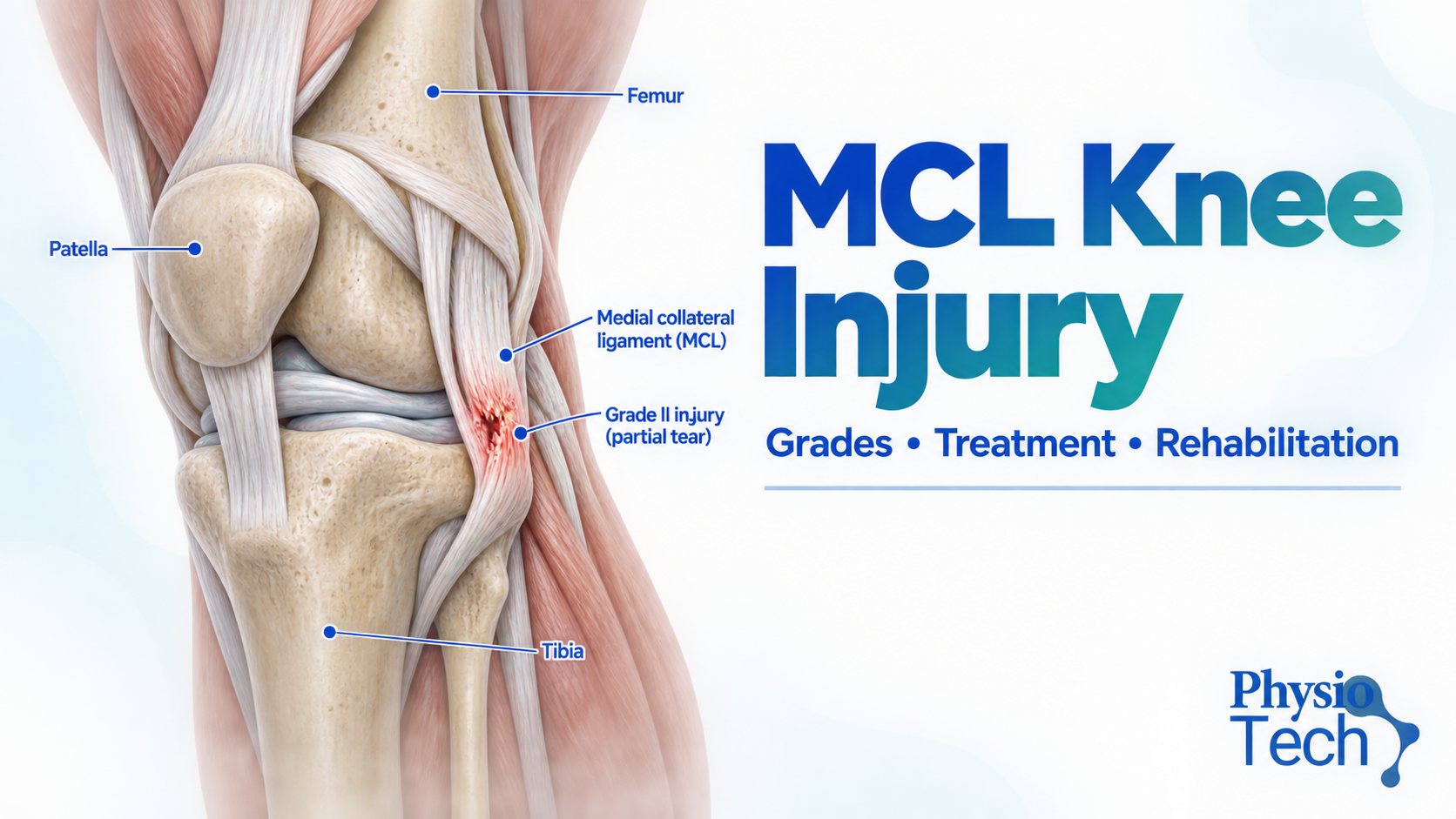
The medial collateral ligament, or MCL, supports the inner side of the knee and helps resist valgus force. It may be injured during cutting, landing, a fall, or a blow to the outside of the knee. Management depends on the injury grade, location, knee stability and associated damage, so a general label such as “knee sprain” is not enough to set a treatment plan or return date.
اقرأ المقال بالعربيةWhat Are the Symptoms of an MCL Injury?
Symptoms may include pain along the inner knee, local swelling, difficulty walking or changing direction, bruising and a feeling that the knee may give way. Rapid joint swelling, a clear pop or major loss of weight-bearing ability can suggest associated ACL, meniscus or bone injury and should be assessed appropriately.
Does Pain Severity Show the Injury Grade?
Not reliably. Assessment considers the mechanism, tenderness, motion, muscle function, valgus stability and task performance. X-ray or MRI may be recommended when a fracture or combined injury is suspected, or when imaging would change management.
MCL Injury Grades
Grade I
A mild fibre injury with local tenderness and relatively preserved stability. Walking may be possible, while running and cutting remain uncomfortable.
Grade II
A partial tear with greater tenderness, swelling and some laxity on testing. Rehabilitation needs measured progression of motion, strength, balance and change-of-direction capacity.
Grade III
A complete tear that may produce clear instability. Many isolated injuries can still be managed non-operatively, but tear location, associated injury and persistent laxity influence the decision. An orthopaedic surgeon determines when surgery is appropriate.
What Should You Do Initially?
1. Stop the activity that causes pain or instability.
2. Use temporary support if walking is unsafe.
3. Avoid forceful stretching or repeatedly testing the ligament.
4. Seek urgent assessment for deformity, inability to bear weight, rapid severe swelling, numbness or a cold foot.
A hinged brace may be useful for selected injuries, but the type and duration should be based on the examination and medical plan.
How Does Physiotherapy Help?
Restore Motion and Settle Irritability
Early rehabilitation protects the ligament while maintaining safe knee motion and limiting stiffness. Flexion and extension are progressed according to symptoms and stability.
Rebuild Strength and Control
Exercise progresses from basic quadriceps activation to resistance training for the quadriceps, hamstrings, calf and hip muscles. Balance, single-leg control, squatting and stair tasks are added as tolerance improves.
Return to Running and Sport
Return should not depend on a fixed number of weeks alone. Useful criteria include minimal pain and swelling, restored motion, strength close to the other limb, stable knee behaviour and the ability to run, hop and change direction without symptoms or loss of control.
Role of Adjunct Treatments
Manual therapy may help selected movement restrictions, while kinesio taping or external support can assist symptoms in some cases. Electrotherapy or therapeutic ultrasound may be used as adjuncts when clinically relevant. These approaches do not restore ligament capacity or movement control on their own and cannot replace assessment, exercise therapy and progressive loading.
MCL Physiotherapy in Zahraa El Maadi, Cairo
At PhysioTech Clinic in Zahraa El Maadi, Cairo, we assess MCL injuries and build individualized rehabilitation plans around injury grade, stability, strength and work or sport demands. Progress is measured with clinical and functional criteria rather than time alone.
Frequently Asked Questions
Does Every MCL Tear Need Surgery?
No. Many isolated MCL injuries are managed without surgery. Combined injuries, persistent instability and certain tear patterns require orthopaedic review.
Do I Need MRI?
Not in every case. Clinical assessment may be sufficient for some injuries, while MRI is useful when associated damage is suspected or the result will influence treatment.
When Can I Run Again?
Running starts when pain, motion, strength and stability allow it. Straight-line running is usually introduced before jumping, cutting and contact tasks.
Is a Brace Always Required?
No. Brace use depends on injury grade, location and stability. One brace protocol does not suit every patient.
Book a knee injury assessment at PhysioTech Clinic in Zahraa El Maadi, Cairo, for an individualized physiotherapy and return-to-sport plan.