Share:
33 views
#إصابة غضروف عظمة الكاحل #Osteochondral lesion talus #ألم عميق بالكاحل #قفل الكاحل #تأهيل الكاحل
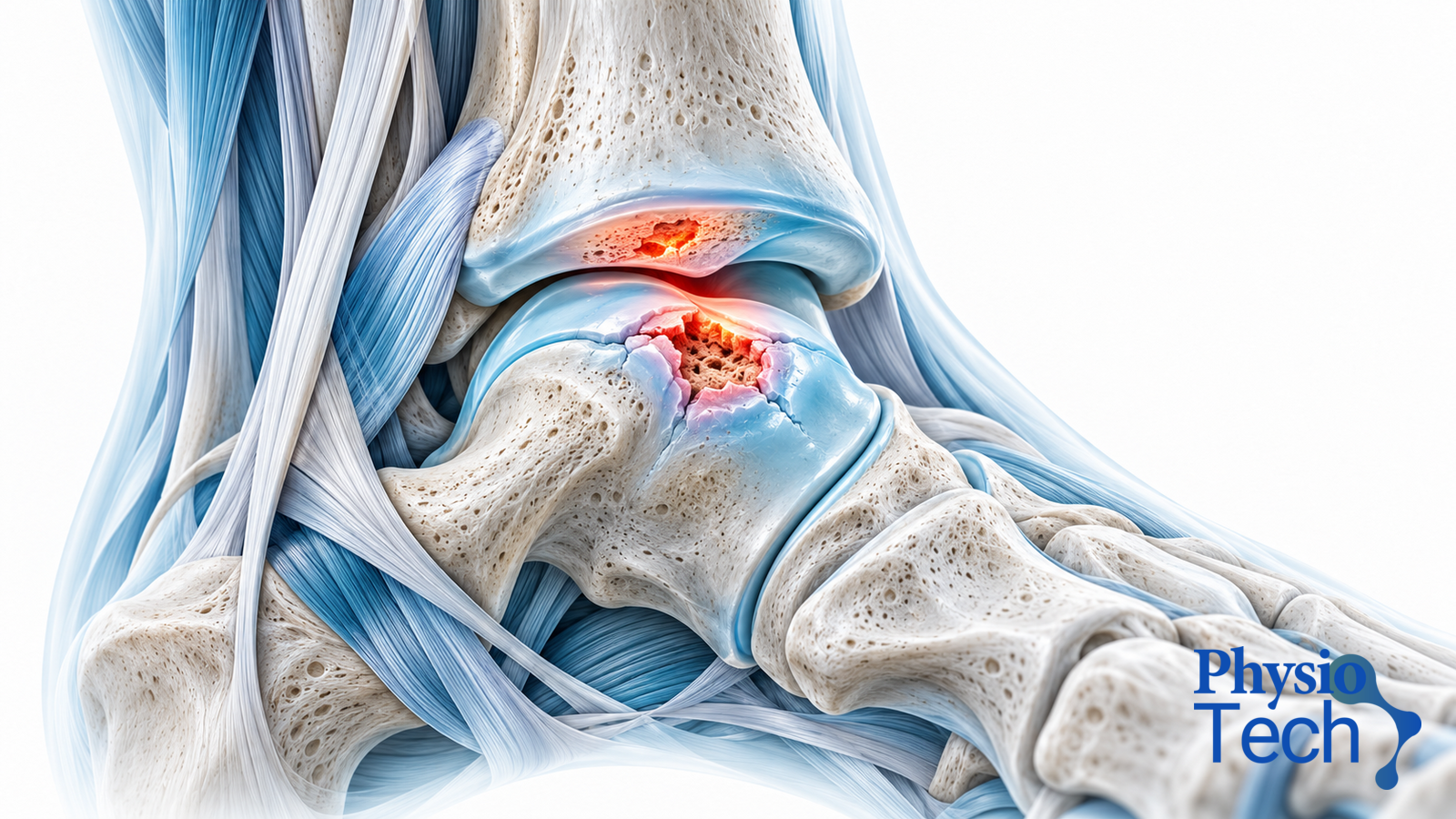
Persistent deep pain, swelling or catching after an ankle sprain can signal an osteochondral lesion of the talar dome. The injury involves cartilage and its underlying bone, and lesions vary in size and stability.
اقرأ المقال بالعربيةThe following information is educational and does not replace an individual examination, especially after major trauma or when warning signs are present.
What Is the Condition?
The talar dome moves within the ankle mortise and carries body weight. A sprain or impact can damage cartilage and subchondral bone. A large or unstable fragment follows a different pathway from a small stable lesion.
Symptoms You May Notice
• Deep ankle pain during weight bearing.
• Recurrent swelling after activity.
• Painful catching, locking or clicking.
• Pain persisting beyond an expected sprain recovery.
• Reduced ankle motion or sports confidence.
Causes and Contributing Factors
Lesions often follow a previous sprain or fracture and may become symptomatic with repeated loading. Size, site, stability, age and activity demands influence decisions; symptoms alone cannot classify the lesion.
Conditions That Can Look Similar
Chronic ankle instability, anterior or posterior impingement, tendon injury, occult fracture, sinus tarsi syndrome and ankle arthritis.
How Is It Assessed at PhysioTech?
We review the original injury, swelling and locking and examine motion, stability, tendons and gait. Mechanical symptoms or persistent pain may lead the physician to MRI or CT to define lesion size and stability.
What Do We Measure?
Swelling, ankle range, walking and stair pain, calf strength and balance, then hopping, landing and cutting after clearance.
We record a meaningful task such as walking, running, stairs or reaching, the response during it and what happens later and the next day. Movement, strength, capacity and task quality are compared over time rather than judging progress only by short-term relief in the session.
When May Imaging or Medical Referral Be Needed?
Fixed locking, inability to bear weight, severe post-traumatic swelling, a loose fragment or persistent symptoms despite rehabilitation needs foot-and-ankle review. Surgical loading restrictions are followed precisely.
Imaging is not required for every patient. It becomes important after major trauma, with warning signs, when progress is unexpectedly poor, or when the result would change loading, referral or surgical decisions. Imaging decisions are coordinated with the appropriate physician.
Osteochondral Lesion of the Talus Treatment at PhysioTech
1. Protect the Area and Manage Load
Modify load and protect the joint according to lesion stability; a boot or non-weight bearing may be medically prescribed, and locking should not be forced through.
2. Restore Movement and Control
Restore ankle motion gradually and improve gait and balance without repeatedly provoking joint irritation.
3. Build Strength and Capacity
Build calf, foot and hip strength from low-impact work toward heel raise and single-leg tasks.
4. Return to Activity or Sport
Add hopping, running and cutting after pain, swelling and strength criteria and medical clearance following surgery.
A central part of care is understanding why each exercise was chosen and how to adjust the dose. We agree on an acceptable symptom response, then progress repetitions, resistance, speed or task complexity. We do not promise a fixed recovery date because injury severity, general health and activity demands vary.
The PhysioTech Treatment Philosophy in Cairo
At PhysioTech Clinic in Zahraa El Maadi, Cairo, care starts with assessment rather than an imaging label alone. We connect symptom behaviour with movement, strength, capacity and work or sport demands, record clear baseline measures and retest them. Manual therapy, dry needling, kinesio taping, electrotherapy or therapeutic ultrasound may be used for a defined purpose, but they do not replace education, therapeutic exercise and graded loading.
No single programme fits every talar lesion. Stability, size and the medical plan define loading boundaries while rehabilitation restores movement, strength and function.
Red Flags That Need Prompt Medical Review
Locking that blocks movement, inability to bear weight, deformity, rapidly increasing pain and swelling, fever with heat, or sensory loss.
Frequently Asked Questions
Is this the same as ankle arthritis?
No. It is a focal cartilage and bone injury, often after trauma, although it can affect the joint over time.
Does it need surgery?
That depends on lesion size, stability, symptoms and response to conservative care.
Is walking allowed?
It depends on stability and medical instructions; one rule cannot cover every lesion.
When Should You Book an Assessment?
If deep pain or locking persists after an ankle sprain, book an assessment at PhysioTech in Cairo and coordinate foot-and-ankle review when needed.
Trusted References
• pmc.ncbi.nlm.nih.gov
• sanfordhealth.org