Share:
108 views
#تمزق العضلة الأمامية #Quadriceps strain #Rectus Femoris #إصابات الملاعب #علاج طبيعي المعادي
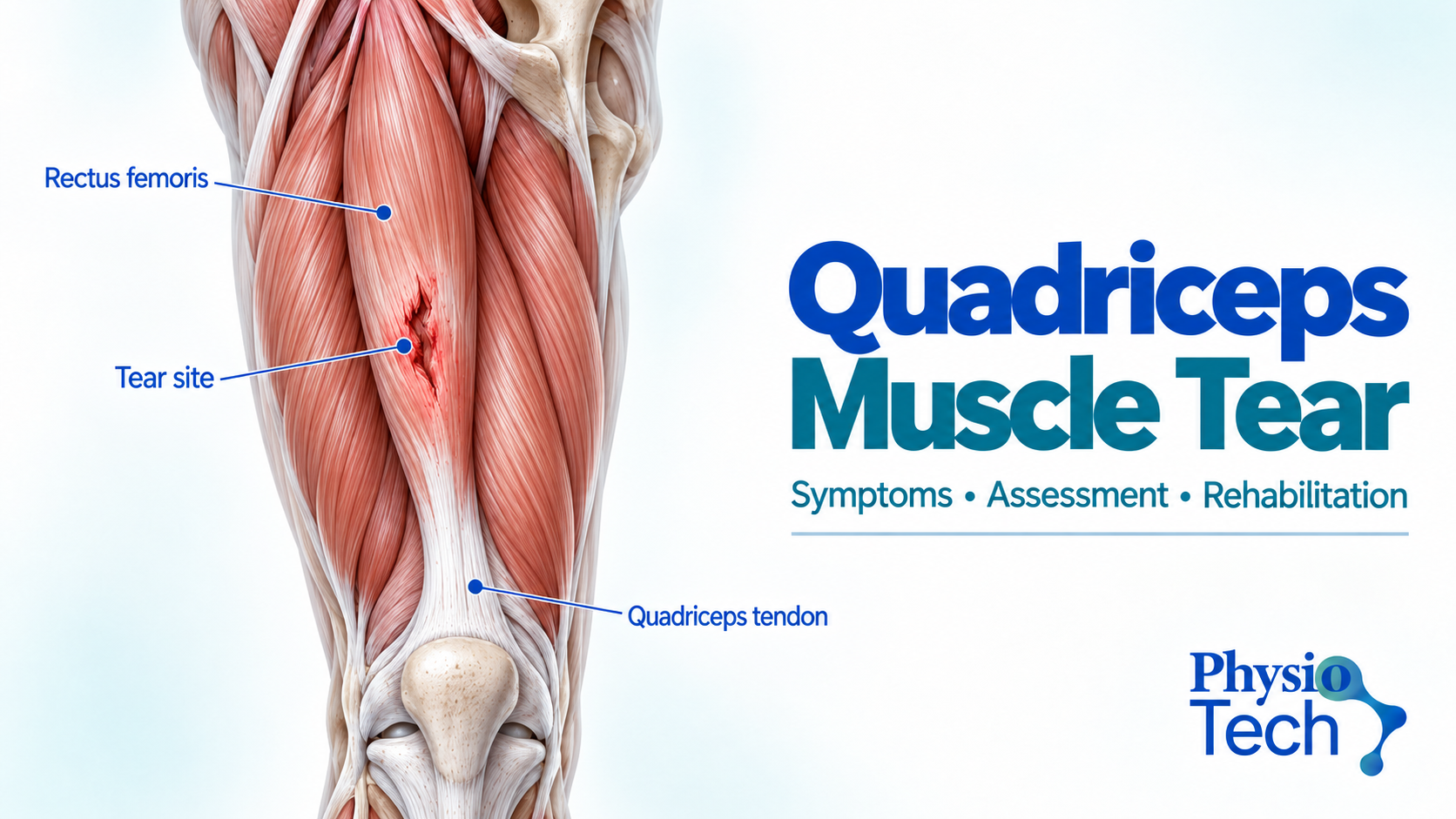
A quadriceps tear usually involves one of the muscles at the front of the thigh. The rectus femoris is commonly injured because it crosses both the hip and knee. Sprinting, kicking, jumping or a forceful stretch can produce a strain. This must be distinguished from a quadriceps tendon rupture above the kneecap, because a complete tendon rupture may require prompt surgical assessment.
اقرأ المقال بالعربيةHow does it happen?
Common mechanisms include forceful kicking, sprint acceleration, sudden jumping, a long-length stretch with the knee bent and hip extended, or a direct blow to the thigh. A direct-impact contusion and an indirect strain are managed differently in the early stage.
Symptoms
Typical features are sudden front-thigh pain, difficulty running, kicking or climbing stairs, pain with resisted knee extension and discomfort when the quadriceps is lengthened. Swelling or bruising may follow a larger injury.
Muscle tear or tendon rupture?
In a quadriceps tendon rupture, the person may be unable to actively straighten the knee or perform a straight-leg raise, and a gap may be felt above the patella. These signs require prompt medical assessment. A partial muscle injury often preserves some movement, although it may be painful and weak.
Assessment and grading
Assessment considers the mechanism, pain location, hip and knee range, strength and function. Imaging may be useful for suspected major tears, tendon rupture or complicated contusions. Traditional grades describe mild, partial and complete injury, but recovery also depends on location, extent, function and sport demands.
Physical therapy stages
Early management
Activity and loading are modified while comfortable hip and knee movement is maintained. Following a direct blow with significant swelling, forceful early massage or stretching may be inappropriate.
Restore strength
Exercise progresses from tolerable contractions to resisted knee extension, squats, split squats and step work. Range and resistance are adjusted to avoid a persistent increase in pain or swelling.
Running, jumping and kicking
Running speed, acceleration, jumping and landing are restored before kicking is progressed from low force to repeated sport-specific effort. A footballer needs repeated-kick tolerance, not only an isolated strength test.
Adjunct treatments
Manual therapy, kinesio taping, electrotherapy or therapeutic ultrasound may support symptom management or movement in selected cases. They do not replace assessment, exercise therapy and progressive loading. Dry needling around an acute tear or hematoma requires careful clinical judgment and is not a routine substitute for rehabilitation.
Return to sport
Return is based on adequate motion, strength and endurance, plus the ability to sprint, jump and kick without a delayed symptom flare. A graded training phase should precede competition; MRI grade alone does not set the date.
Frequently asked questions
Is every front-thigh pain a tear?
No. Hip, knee, nerve and direct-impact problems can produce similar pain, so the mechanism and examination matter.
Can I walk after a quadriceps strain?
Walking is often possible after a mild injury if it does not create a marked limp or lasting flare. Inability to walk or actively straighten the knee needs prompt assessment.
Is stretching essential?
Range is restored progressively. Aggressive early stretching is not required and may aggravate symptoms.
When can kicking resume?
After strength, range and running capacity improve, kicking is progressed from low force to repeated match-like demands.
If front-thigh pain is limiting running or kicking, book an assessment at PhysioTech Clinic in Zahraa El Maadi.