Share:
32 views
#تمزق وتر العضلة الرباعية #Quadriceps tendon tear #قطع وتر الركبة #تأهيل بعد جراحة الركبة #علاج طبيعي القاهرة
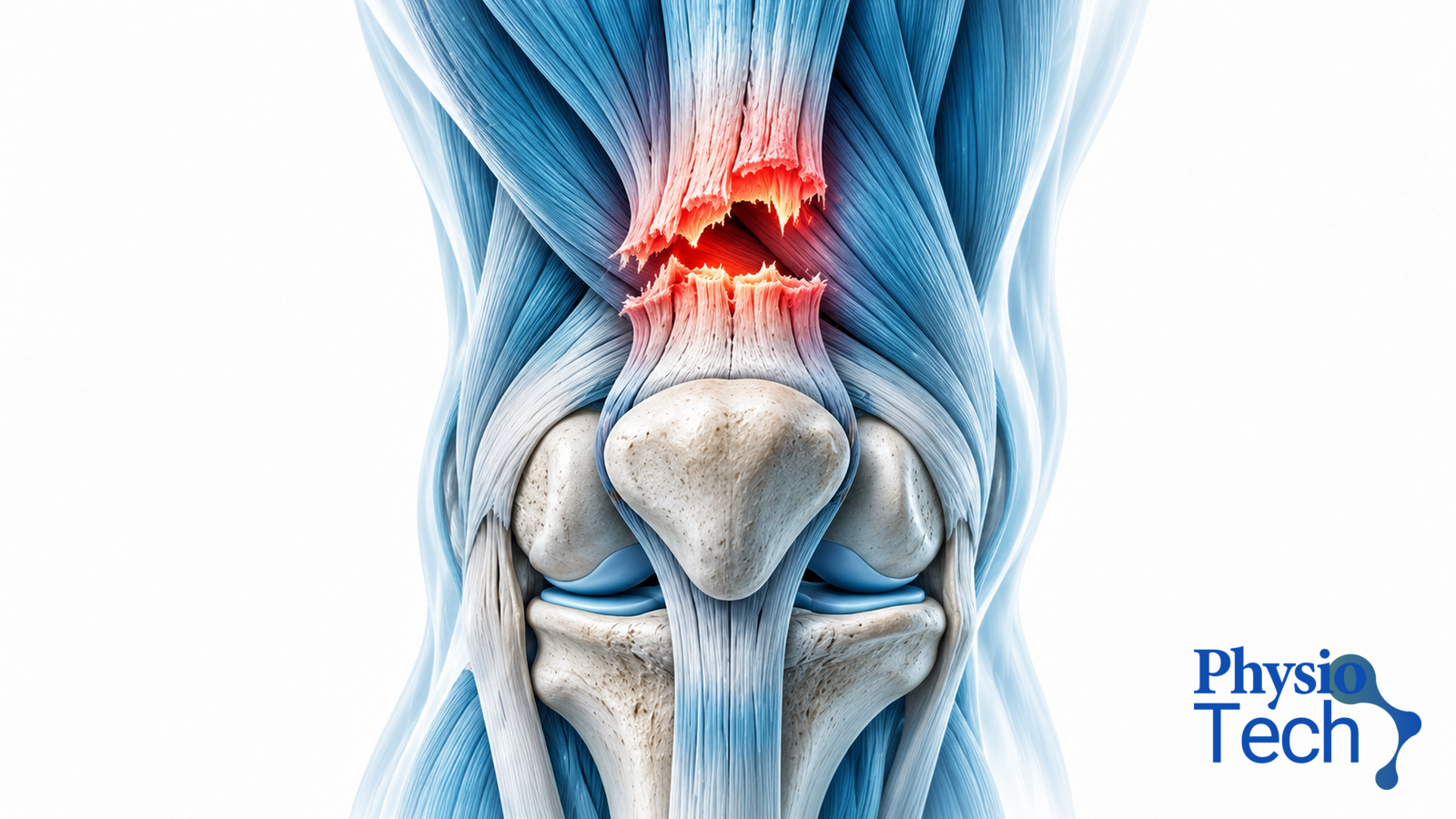
A complete quadriceps tendon rupture is a significant injury because it disrupts the knee extensor mechanism. A pop, swelling above the kneecap and loss of straight-leg raise can occur. Early orthopaedic assessment matters because complete tears commonly require surgical repair.
اقرأ المقال بالعربيةThe following information is educational and does not replace an individual examination, especially after major trauma or when warning signs are present.
What Is the Condition?
The quadriceps tendon joins the four anterior-thigh muscles to the top of the patella. A partial tear leaves some fibres in continuity; a complete rupture separates the tendon and interrupts force transfer to the kneecap and lower leg.
Symptoms You May Notice
• Sudden pain or a pop above the patella after a fall or jump.
• Swelling, bruising or a palpable gap.
• Marked weakness or inability to straighten the knee.
• Loss of a straight-leg raise.
• Unstable gait or knee buckling.
Causes and Contributing Factors
The tendon can fail during a forceful contraction as the knee bends. Tendon quality, chronic disease, certain medicines or previous surgery may increase risk. Gradual quadriceps tendinopathy is different from an acute rupture.
Conditions That Can Look Similar
Quadriceps tendinopathy, patellar fracture or dislocation, patellar-tendon rupture, muscle injury, or severe swelling that inhibits activation without a complete tear.
How Is It Assessed at PhysioTech?
We examine active extension, straight-leg raise, swelling and the injury site, plus sensation and circulation. An orthopaedic physician confirms tear severity with appropriate imaging and decides between conservative and surgical management.
What Do We Measure?
Once rehabilitation is cleared, we track extension and flexion, swelling, quadriceps activation, gait and stairs, progressing to limb strength and functional tests when appropriate.
We record a meaningful task such as walking, running, stairs or reaching, the response during it and what happens later and the next day. Movement, strength, capacity and task quality are compared over time rather than judging progress only by short-term relief in the session.
When May Imaging or Medical Referral Be Needed?
Inability to straighten the knee or raise the leg after an acute injury needs same-day assessment. After surgery, wound heat or discharge, sudden calf pain or breathlessness requires urgent medical contact.
Imaging is not required for every patient. It becomes important after major trauma, with warning signs, when progress is unexpectedly poor, or when the result would change loading, referral or surgical decisions. Imaging decisions are coordinated with the appropriate physician.
Quadriceps Tendon Tear Treatment at PhysioTech
1. Protect the Area and Manage Load
Follow the surgeon’s restrictions for brace, weight bearing and motion. Flexion or resistance is not advanced beyond repair-protection limits; swelling control and safe mobility reduce complications.
2. Restore Movement and Control
Restore full extension and quadriceps activation, then progress flexion according to the operation and wound status. Movement quality matters more than chasing a rapid angle.
3. Build Strength and Capacity
Add closed-chain strength and later greater extensor resistance when permitted, together with hip, calf, gait and stair training.
4. Return to Activity or Sport
Running and jumping require adequate strength, control, capacity and relevant testing, not merely elapsed weeks. Unexpected pain or delay is discussed with the surgeon.
A central part of care is understanding why each exercise was chosen and how to adjust the dose. We agree on an acceptable symptom response, then progress repetitions, resistance, speed or task complexity. We do not promise a fixed recovery date because injury severity, general health and activity demands vary.
The PhysioTech Treatment Philosophy in Cairo
At PhysioTech Clinic in Zahraa El Maadi, Cairo, care starts with assessment rather than an imaging label alone. We connect symptom behaviour with movement, strength, capacity and work or sport demands, record clear baseline measures and retest them. Manual therapy, dry needling, kinesio taping, electrotherapy or therapeutic ultrasound may be used for a defined purpose, but they do not replace education, therapeutic exercise and graded loading.
Tendon protection and strength restoration are not opposites. Appropriate stage-specific loading limits stiffness and deconditioning without exposing the repair to avoidable risk.
Red Flags That Need Prompt Medical Review
New loss of knee extension, a fall with a postoperative pop, marked wound redness or discharge, fever, sudden calf swelling, chest pain or breathlessness needs urgent review.
Frequently Asked Questions
Does every tear need surgery?
Complete ruptures commonly require repair, while selected partial tears may be managed conservatively under specialist review.
When can knee bending start?
It depends on the repair and the surgeon’s instructions; no single week or angle fits everyone.
Does pain mean the tendon has torn again?
Not necessarily, but a new pop with loss of extension or major swelling requires urgent assessment.
When Should You Book an Assessment?
After a quadriceps tendon tear or repair, book staged rehabilitation at PhysioTech in Zahraa El Maadi, Cairo, coordinated with your surgeon.
Trusted References
• orthoinfo.org
• lahey.org