Share:
3 views
#متلازمة النفق الكعبري #Radial tunnel syndrome #ألم الساعد #العصب الكعبري
What Is Radial Tunnel Syndrome?
Outer-elbow pain that travels into the forearm is not always tennis elbow. Tissues around the radial nerve may become irritable as it passes between forearm muscles, requiring a careful differential assessment.
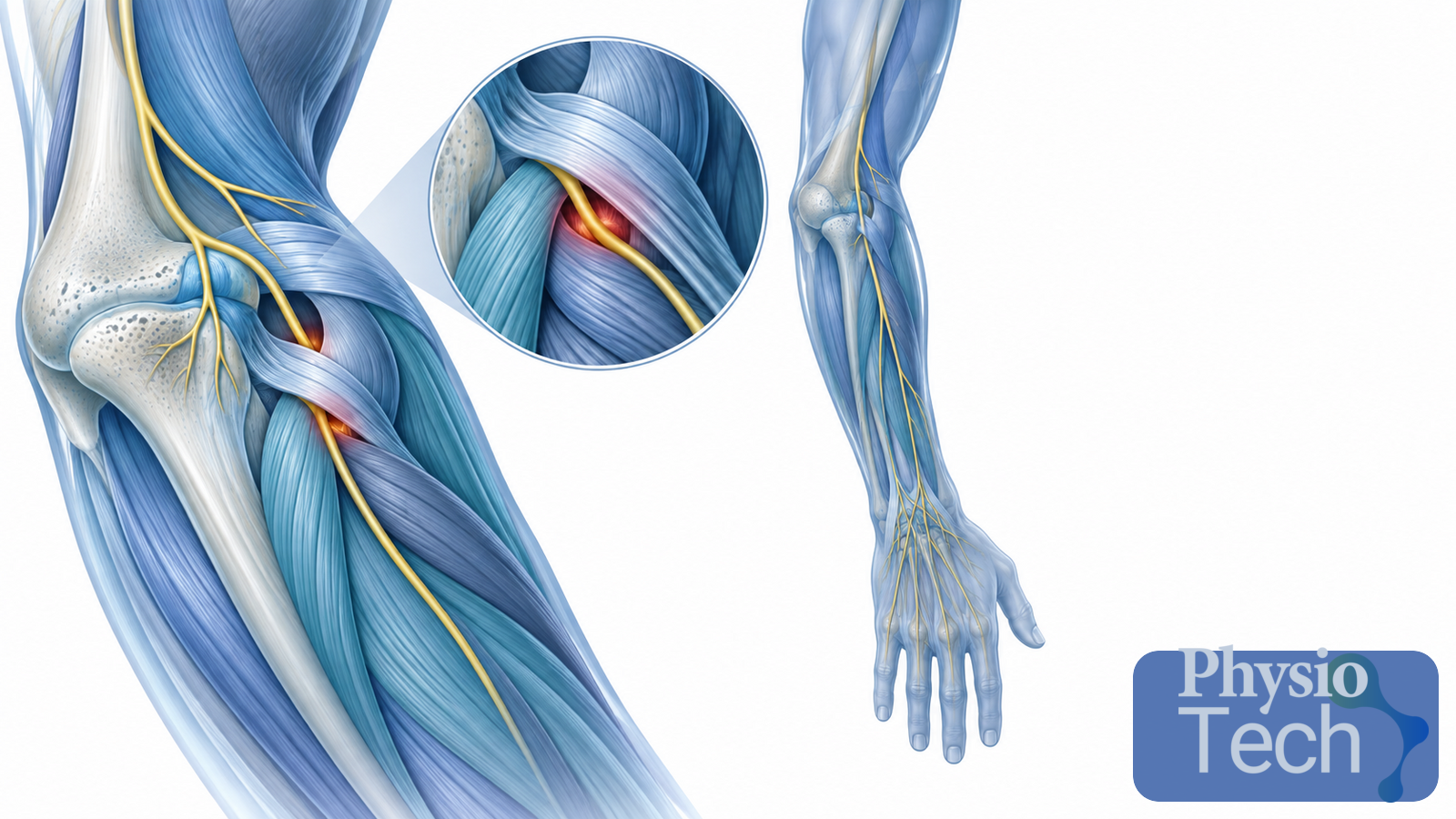
The radial tunnel is the region where the deep radial nerve passes near the supinator. Irritation often creates deep forearm pain rather than prominent numbness.
No single test confirms the diagnosis. Pain location and the response of tendons, nerves, the neck and repeated tasks must be compared.
Common Symptoms
• Deep outer-elbow pain extending down the dorsal forearm.
• Pain with forearm rotation or resisted finger extension.
• Fatigue during grip, screwdriver use or mouse work.
• Often little or no obvious numbness.
Causes and Aggravating Factors
Repeated rotation and grip, sudden loading, high training volume or muscular compression can increase symptoms. Radial tunnel and lateral elbow tendinopathy may coexist.
Conditions That Can Look Similar
Tennis elbow, cervical or proximal radial nerve irritation, supinator injury and elbow-joint disorders.
How PhysioTech Assesses the Condition
We map symptoms and assess the neck, elbow and wrist, finger and wrist extension strength, radial nerve sensitivity and the exact task that provokes pain.
Baseline Measures
Work duration before pain, grip force, response to resisted supination or middle-finger extension, and tolerance to typing or lifting.
When Imaging or Medical Referral May Be Needed
Progressive true weakness in finger or wrist extension, widespread sensory loss, acute trauma or an unusual mass requires medical review and possibly nerve testing or imaging.
Radial Tunnel Syndrome Treatment and Physiotherapy
1. Settle Symptoms and Manage Load
Temporarily reduce the combination of forceful grip and repeated rotation, and pace work while maintaining activity that does not cause a prolonged flare.
2. Restore Movement and Control
Restore comfortable elbow and forearm movement. Gentle neural mobility may be used only when it remains tolerable and does not worsen neurological symptoms.
3. Build Strength and Capacity
Progress forearm and shoulder strength so the system can tolerate grip, rotation and repetitive work.
4. Return to Work or Sport
Return to training or work with reduced duration and resistance, then progress according to same-day and next-day response.
The PhysioTech Treatment Philosophy in Cairo
At PhysioTech Clinic in Zahraa El Maadi, Cairo, the plan is not built on an imaging label alone. We connect symptoms with movement, strength, capacity and the activities the patient wants to regain. Clear baseline measures are recorded and retested. Manual therapy or other adjuncts may be used for a defined purpose, but they never replace therapeutic exercise, graded loading and reassessment.
We do not apply one generic plan to every lateral-elbow pain. Distinguishing tendon, nerve and cervical contributions guides treatment.
Red Flags That Need Prompt Medical Review
Increasing weakness, dropping objects, muscle wasting, major trauma, colour change or persistent pain unrelated to movement.
Frequently Asked Questions
How is this different from tennis elbow?
Tennis elbow is often most tender at the tendon origin, while radial tunnel pain may sit deeper and farther down the forearm. They can coexist.
Is the nerve torn?
Usually not. The term commonly describes irritation or compression; true motor loss must be assessed promptly.
Is rest enough?
Load modification helps, but restoring capacity and task technique is important for durable improvement.
When Should You Book an Assessment?
Forearm pain that persists despite a tennis-elbow plan deserves a broader assessment of the tendon, nerve and neck. You can book an individual assessment at PhysioTech Clinic in Zahraa El Maadi, Cairo, to build a plan around your presentation and goals.