Share:
60 views
#إصابة المفصل الأخرمي الترقوي بعد الوقوع على الكتف #Acromioclavicular Joint Injury After a Shoulder Fall
Understanding Acromioclavicular Joint Injury After a Shoulder Fall
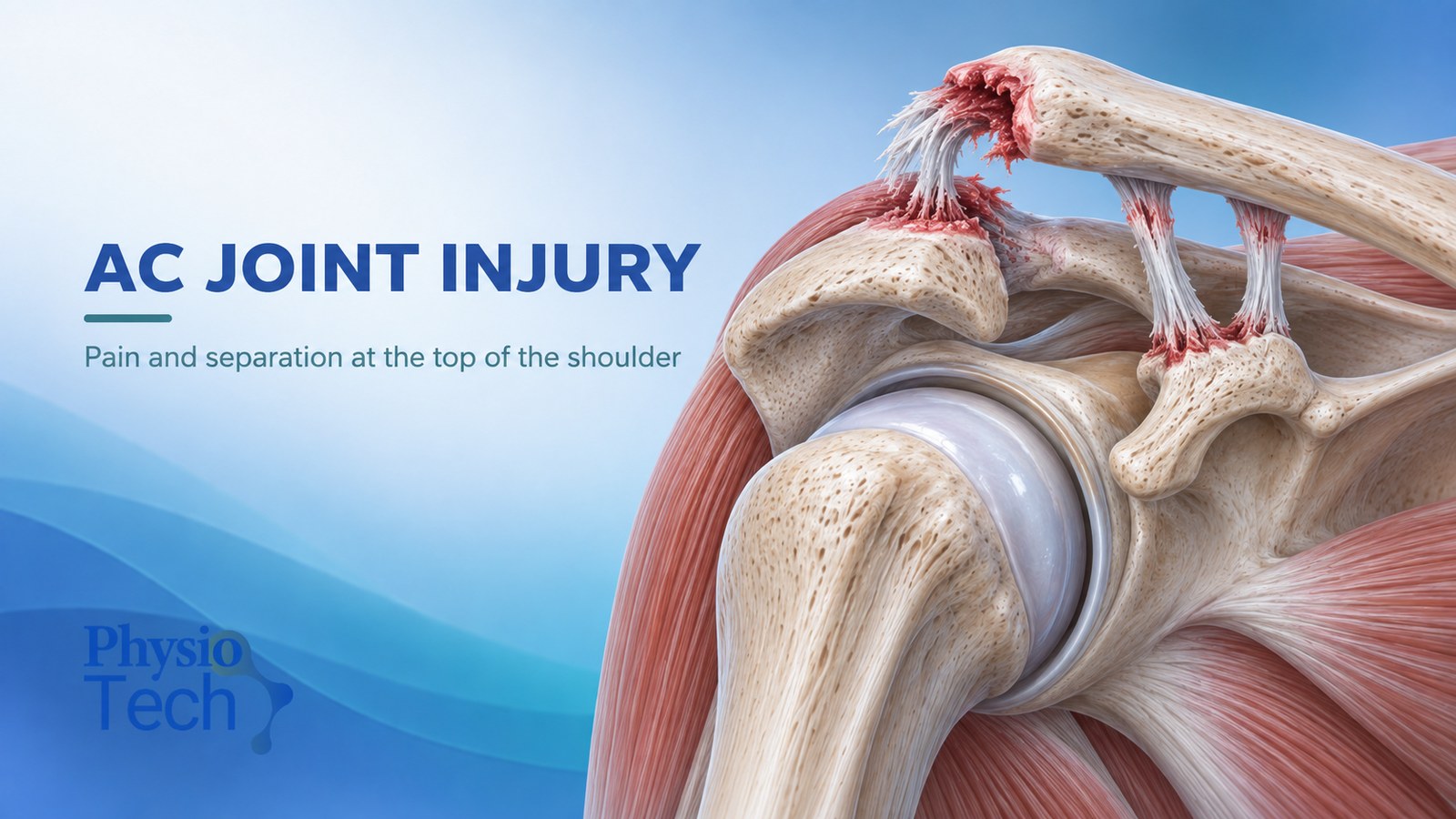
The acromioclavicular (AC) joint connects the outer clavicle to the acromion at the top of the shoulder. Injury commonly follows a direct fall onto the shoulder during sport or an accident.
Symptoms and Clinical Assessment
Typical features include focal pain on top of the shoulder, pain with arm elevation or cross-body reach, swelling or bruising, difficulty lying on the injured side and, in higher grades, a visible prominence. Appearance alone does not determine pain or function.
Physiotherapy and Rehabilitation
Progressive Exercise and Load Management
Lower grades usually involve sprain or partial ligament disruption, while higher grades may involve greater displacement. Assessment considers tenderness, movement, strength, neurological and circulation findings. X-rays may help grade the injury and exclude fracture after trauma.
Return to Activity and When Medical Review Is Important
Early management controls pain and load; a sling may be used for a clinician-defined period while safe elbow, hand and shoulder movement is maintained. Rehabilitation progressively restores motion, rotator-cuff and scapular capacity, pushing, pulling and sport-specific contact tolerance. Adjuncts may help short-term symptoms, but they do not replace graded movement and strengthening.
Frequently Asked Questions
Common Questions About Recovery and Treatment
Many low- and selected mid-grade injuries are managed nonoperatively. Higher-grade injuries, persistent disability or major occupational and sporting demands require individual discussion with a shoulder surgeon. Return is based on motion, strength, load tolerance and task performance, not only time.
Book an Assessment at PhysioTech
Seek prompt medical review for major deformity, severe pain after high-energy trauma, inability to move the arm, hand numbness or coldness, an open wound or suspected fracture.
FAQ: A bump may remain despite good function. Exercise timing depends on grade, symptoms and medical advice. Pain on top of the shoulder is not always an AC injury, so examination matters.
Local CTA: If a fall caused focal pain on top of your shoulder, book an assessment at PhysioTech Clinic in Zahraa El Maadi to define the injury and plan a safe return to work and sport.