Share:
130 views
#تمزق العضلة الضامة #Adductor tear #Groin strain #إصابات الملاعب #علاج طبيعي المعادي
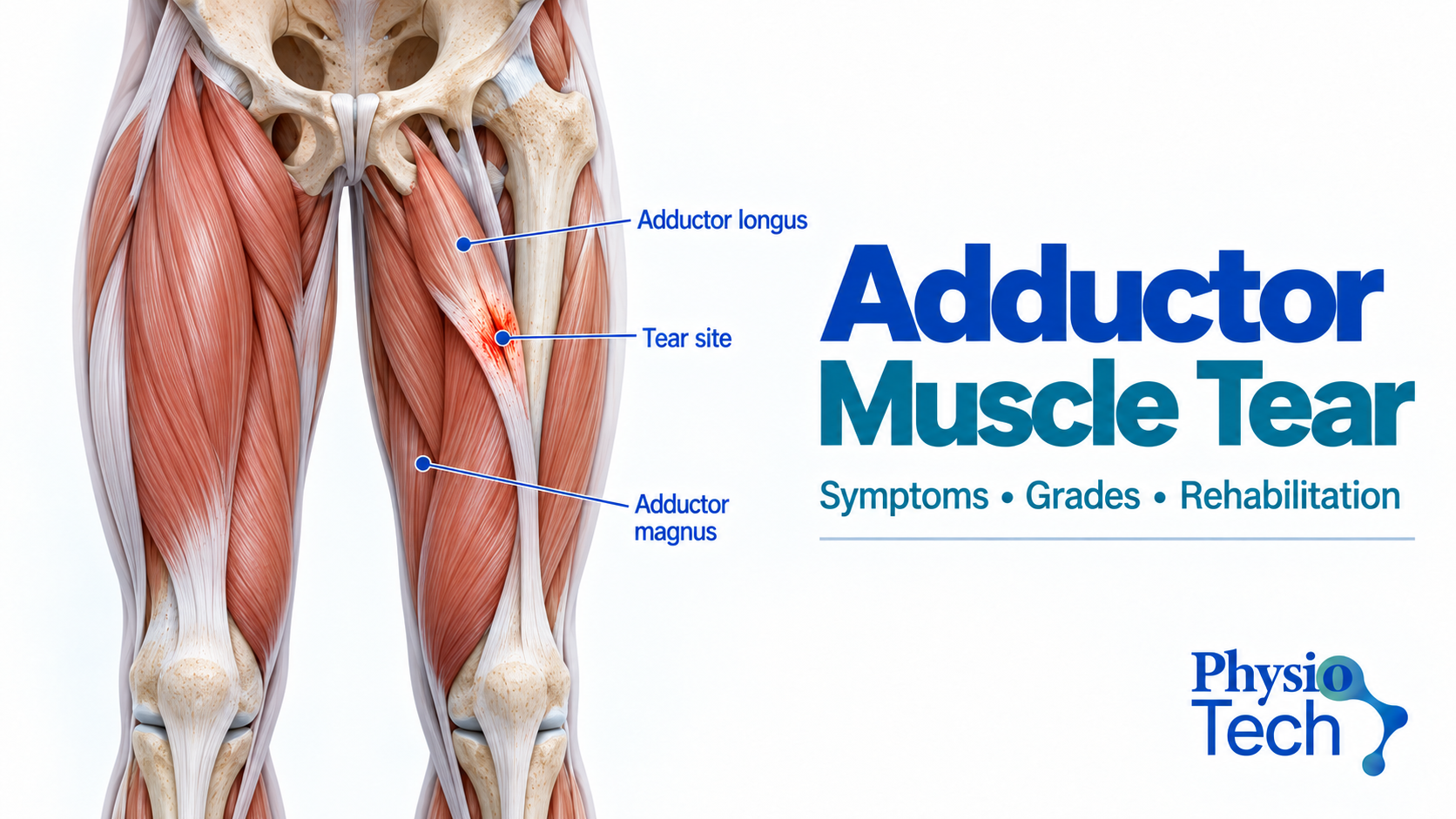
An adductor muscle tear is an acute injury of the inner-thigh muscles, often occurring during sprinting, cutting, kicking or a sudden wide step. Groin pain does not automatically confirm an adductor tear because the hip joint, abdominal wall, tendons and other structures can produce similar symptoms.
اقرأ المقال بالعربيةWhat do the adductor muscles do?
The adductors help bring the leg toward the midline, control the pelvis and manage force during running and changes of direction. The adductor longus is frequently involved in athletic groin injuries, although other muscles and the muscle-tendon junction may also be affected.
Common causes
1. A rapid increase in sprinting, kicking or cutting load.
2. A slip or forced wide-leg position.
3. High-speed kicking while fatigued.
4. Returning to sport before strength and high-speed capacity are restored.
5. Previous groin injury and insufficient sport-specific conditioning.
Symptoms and warning signs
Typical symptoms include sudden inner-thigh or groin pain, pain when squeezing the legs together and difficulty accelerating or changing direction. Bruising or swelling may appear after a larger tear.
When is urgent assessment appropriate?
Urgent medical assessment is appropriate when there is marked strength loss, a palpable gap, extensive bruising, inability to walk, severe unremitting pain, or abdominal and urinary symptoms.
Understanding injury grades
Grade 1 usually describes a mild injury with limited strength loss, grade 2 a more substantial partial tear, and grade 3 a complete tear or avulsion. These labels are not a recovery clock. Injury location, tendon involvement, functional demands and response to loading all influence rehabilitation.
How is it assessed?
Assessment includes the injury mechanism, pain location, hip movement, adduction strength, walking and sport-specific tasks. Diagnostic ultrasound or MRI may be useful for suspected major tears or possible tendon avulsion, but imaging should be interpreted alongside the clinical examination.
Physical therapy rehabilitation
Early phase
The first aim is to settle symptoms without unnecessary complete rest. Comfortable movement and appropriately dosed isometric exercise can maintain capacity. Manual therapy, kinesio taping or electrotherapy may support symptom management, but they do not replace assessment, exercise and progressive loading.
Strength phase
Loading progresses from low-force contractions to resisted adduction through different ranges, single-leg control and trunk and pelvic training.
Running and change of direction
Straight-line running is reintroduced gradually before acceleration, deceleration, lateral movement and kicking. Progression depends on symptom response, movement quality and force capacity rather than a fixed calendar.
Return-to-sport criteria
A safer decision considers minimal pain, adequate strength, repeated sprinting, cutting and kicking capacity, and completion of controlled sport training before full participation.
Frequently asked questions
Does an adductor tear require surgery?
Most partial muscle injuries are treated non-operatively. Complete avulsions or major tears require specialist assessment.
How long does recovery take?
It varies with severity, location, tendon involvement and sport demands. Functional criteria are more reliable than a universal timetable.
Is walking allowed?
Walking is often acceptable if it does not produce a marked limp or lasting symptom increase, but this should be individualized.
Is massage enough?
No. Hands-on treatment may ease symptoms, but strength, load tolerance and sport-specific capacity must be rebuilt.
If inner-thigh pain is limiting running or kicking, book an assessment at PhysioTech Clinic in Zahraa El Maadi.