Share:
140 views
#تمزق عضلة السمانة #Calf strain #Gastrocnemius #Soleus #العودة للجري
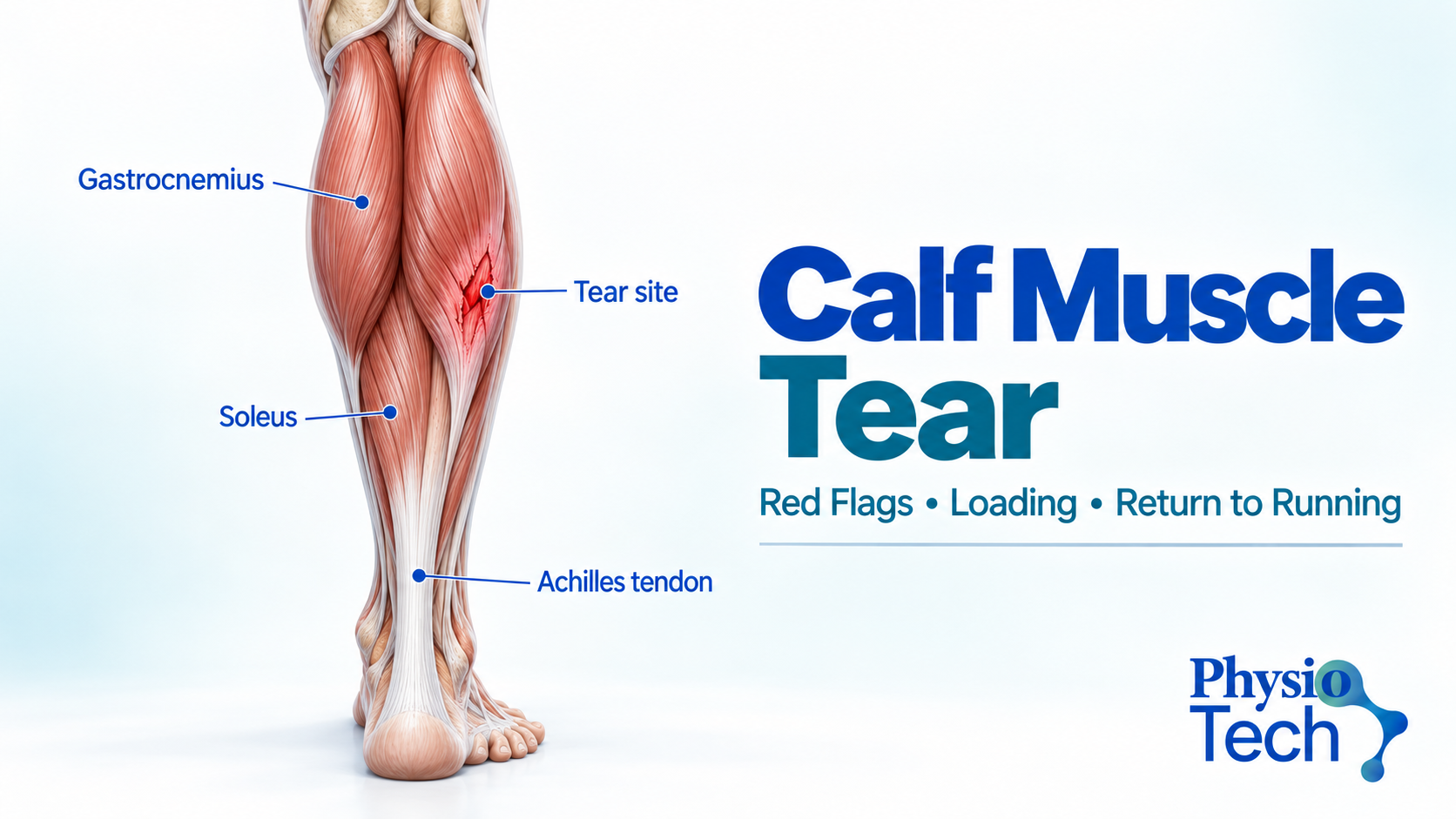
A calf tear can occur during push-off, sprinting, jumping or a rapid change of speed. The gastrocnemius and soleus may be involved in different patterns. Assessment matters because sudden posterior-leg pain can resemble an Achilles tendon rupture, while unexplained swelling and warmth may require urgent assessment for deep-vein thrombosis.
اقرأ المقال بالعربيةCommon symptoms
Some people describe feeling as if they were struck in the back of the leg. Walking quickly, climbing stairs and rising onto the toes may be painful. Swelling or bruising can develop, but its appearance does not determine the exact injury grade.
Red flags requiring medical assessment
Seek urgent care for unexplained one-sided swelling with warmth or redness, chest pain or shortness of breath, major loss of push-off, suspected Achilles rupture or severe pain after a high-force injury. Physical therapy should not begin before a suspected clot or complete tendon injury is appropriately assessed.
How is it assessed?
Assessment includes the mechanism, walking pattern, pain location, ankle range and calf-raise capacity. Diagnostic imaging may be appropriate when a major tear or Achilles injury is suspected, while vascular testing is used when DVT is a concern.
Rehabilitation stages
Restore walking and ankle movement
Load is adjusted to reduce a marked limp while maintaining safe ankle movement and tolerable calf contraction. Prolonged complete rest can cause additional loss of capacity.
Build calf strength and endurance
Calf raises progress from two legs to one leg, and from straight-knee to bent-knee positions. Resistance, range and volume are increased according to symptom response and performance.
Reintroduce hopping and running
Low-level elastic work is introduced after a strength base is established, followed by brisk walking, run-walk intervals and gradual acceleration. Athletes require repeated-effort capacity, not merely one pain-free calf raise.
PhysioTech rehabilitation approach
At PhysioTech Clinic, the plan measures walking, ankle motion, calf-raise strength, elastic capacity and running tolerance. Manual therapy, kinesio taping, electrotherapy or therapeutic ultrasound may be used selectively as adjuncts; they do not replace assessment, exercise therapy and progressive loading.
Frequently asked questions
Is a calf tear the same as an Achilles rupture?
No. Both can cause posterior-leg pain, but location, clinical tests and push-off function differ, and Achilles injuries may require a different pathway.
Do I need crutches or a brace?
Temporary support may help reduce a significant limp in selected cases, but it should be individualized.
When can calf raises begin?
They begin at a tolerable level when assessment indicates it is appropriate, then progress in load and volume.
When can I run again?
After comfortable walking, adequate ankle motion and sufficient calf strength and elastic tolerance, followed by a graded running plan.
If sudden calf pain is limiting walking or running, book an assessment at PhysioTech Clinic in Zahraa El Maadi.