Share:
30 views
#PhysioTech #Cairo #evidence-based physiotherapy #Lumbar Traction
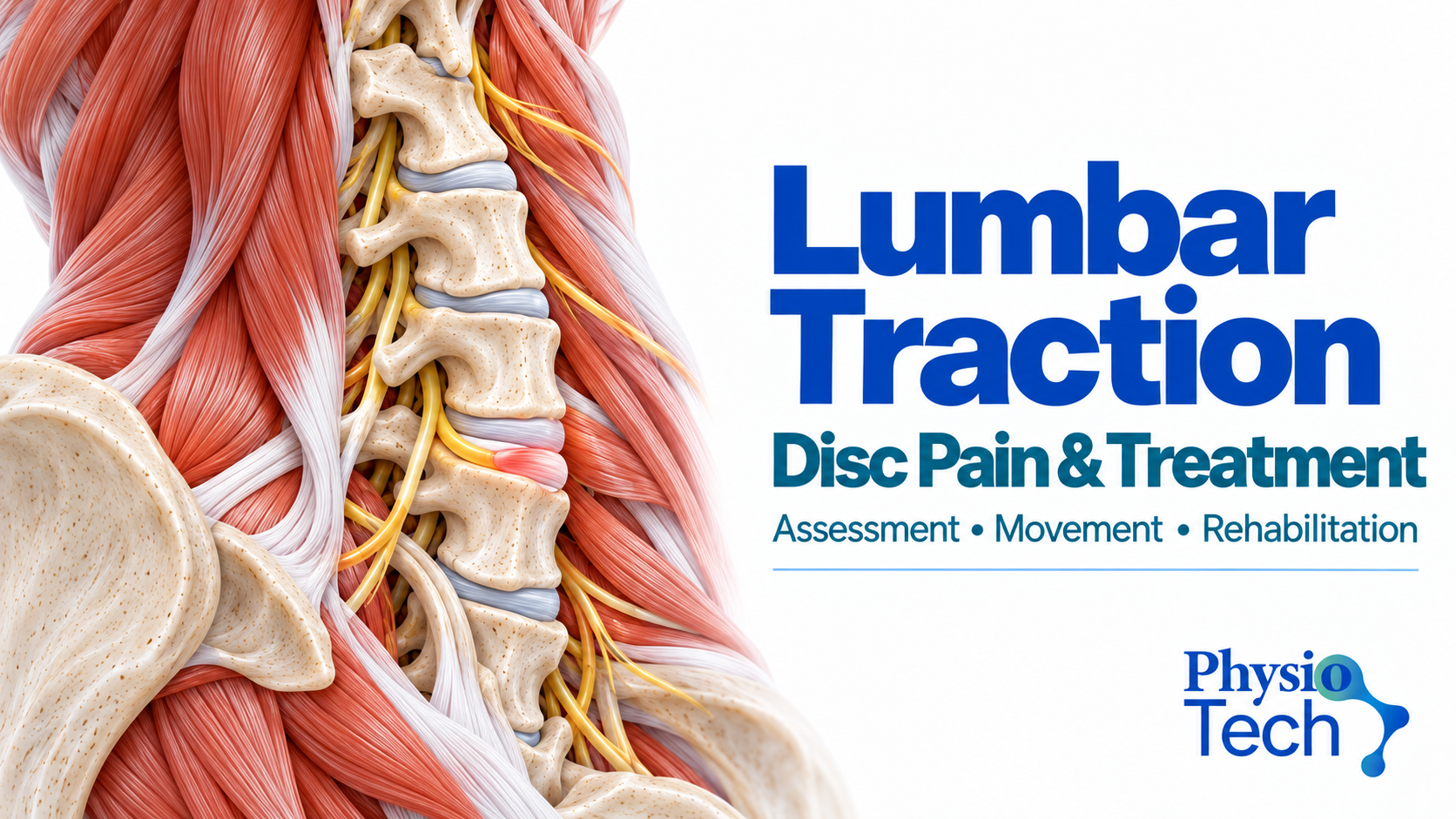
Does a traction machine put a slipped disc back into place? This common question deserves a clear answer: lumbar traction is not a guaranteed disc repair. Feeling comfortable after a session does not establish that the disc has been corrected or that traction should become the centre of treatment. The useful starting point is a clinical assessment, including nerve function when appropriate, followed by a plan for everyday movement. This article addresses lumbar traction, not every form of traction or cervical treatment.
اقرأ المقال بالعربيةWhat is lumbar traction?
An external pulling force
A harness or machine applies an external pulling force to the lower back. Position, force and session duration vary. A description of separating vertebrae is a mechanical explanation, not proof of a meaningful clinical benefit. An intervertebral disc is living tissue, not a displaced bone that simply needs pulling back. A marketing illustration cannot demonstrate what will happen to an individual patient.
What do guidelines say?
Recommendations have a defined scope
NICE NG59 advises against traction for low back pain with or without sciatica. The 2023 WHO guideline also advises against routine traction for chronic primary low back pain. These recommendations concern defined populations; they do not justify a blanket statement about every traction technique in every body region. They also do not mean that someone reporting temporary comfort imagined that experience.
Temporary relief is not the same as recovery
Measure life beyond the session
Symptoms may settle on the treatment couch and return during sitting or walking. Ask whether sleep, work tolerance and leg symptoms are improving. Success is not defined only by how the back feels immediately after treatment. Repeated short-lived relief without functional progress should prompt a review of the assessment and plan, rather than an automatic extension of machine sessions.
Assessment before selecting treatment
Symptoms and examination come first
The assessment considers symptom onset, distribution and response to activity. Leg symptoms may require examination of strength, sensation and reflexes. MRI findings need clinical interpretation: a reported disc bulge does not explain every symptom automatically. Imaging is not required for everyone; the clinician decides whether it is likely to change management.
PhysioTech’s physiotherapy approach
An adaptable active plan
At PhysioTech in Zahraa El Maadi, Cairo, Egypt, the plan starts with understandable explanations and practical goals such as sitting tolerance or returning to walking. Movement and exercise progress according to the response. Manual therapy may support comfortable movement when suitable; it is not presented as a guaranteed disc repositioning procedure. Home activity and loading are reviewed rather than applying one exercise to every back problem.
When is urgent assessment needed?
Do not delay serious neurological symptoms
New urinary retention or loss of bladder control, numbness around the saddle area, or progressive weakness requires urgent medical assessment. Significant trauma, fever or systemic illness also needs appropriate evaluation. Do not respond by trying home traction or increasing a machine’s force. This information is educational, not an individual diagnosis or instructions for operating a device.
Frequently asked questions
Can traction replace exercise?
No. Treatment is organised around your presentation and goals, not a machine. If an adjunct helps symptoms, regaining movement tolerance and function remains essential.
Does every disc herniation need surgery?
No. Symptoms, examination and the course of the condition guide decisions. Serious neurological signs or progressive weakness need prompt medical evaluation rather than waiting through treatment sessions.
Does this also cover cervical traction?
No. Lumbar and cervical evidence should not be conflated. Cervical traction has a separate article and requires its own clinical assessment.
Assessment and treatment planning in Cairo
If this issue affects movement or work, you can book an assessment at PhysioTech in Zahraa El Maadi, Cairo, Egypt. We discuss your goals and examination findings, explain the options and limitations of each intervention, and agree an appropriate review plan. An article cannot determine the required number of sessions or guarantee an outcome; individual assessment is necessary.